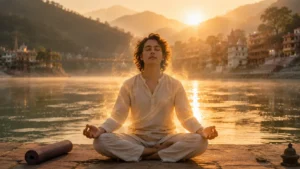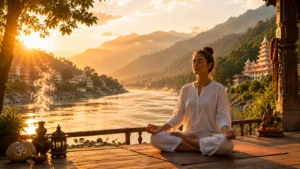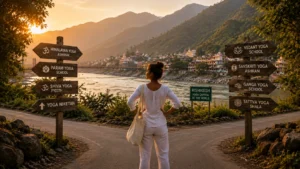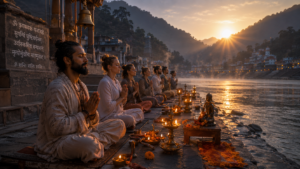


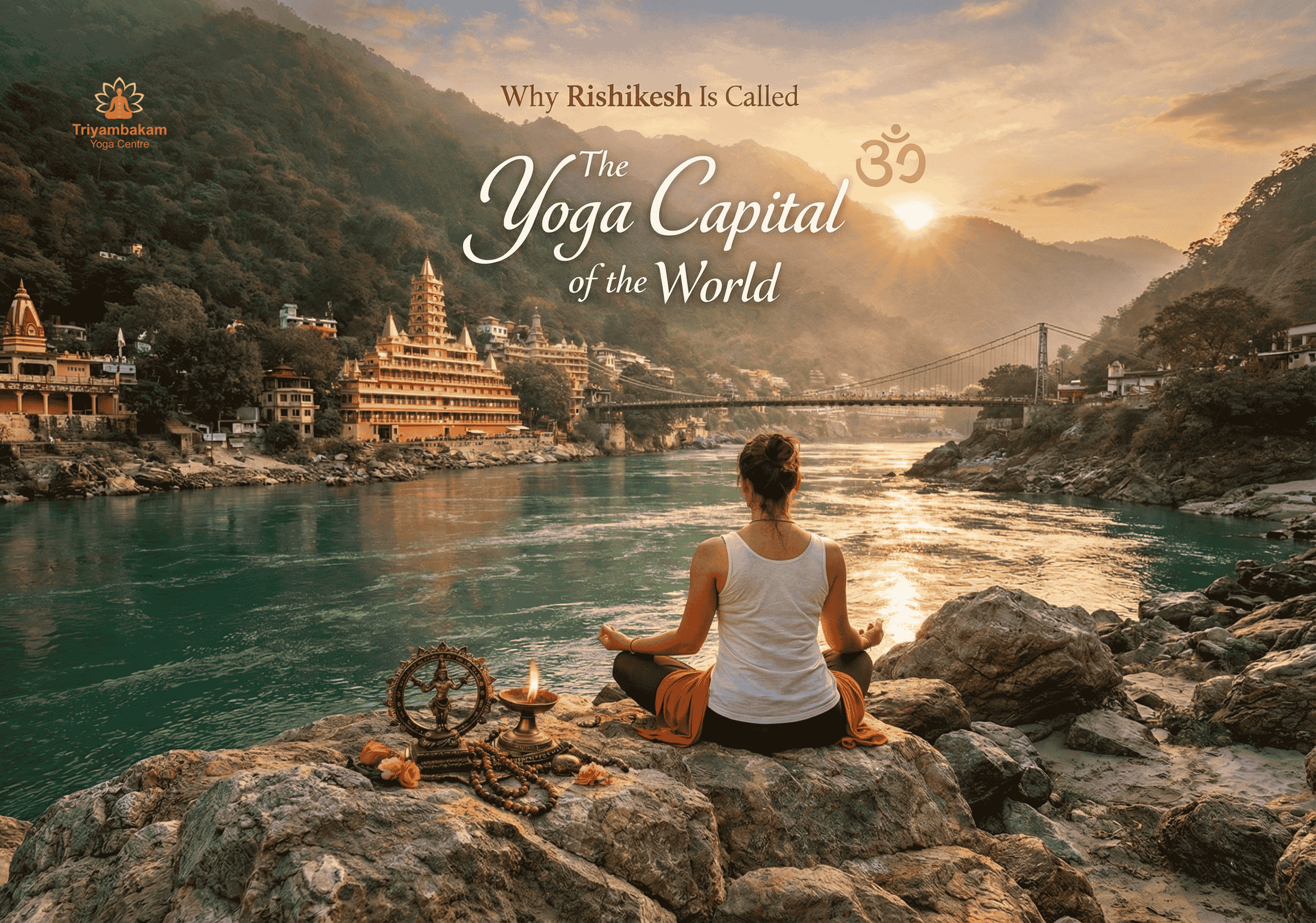
Why Most People Misunderstand Why Rishikesh Is Called the Yoga Capital of the World
Symptom: People visit Rishikesh expecting instant spiritual awakening, dramatic inner experiences, or some visible transformation. Many leave confused. Some feel deeply changed but cannot explain why. Others return home saying, “It was peaceful, but I don’t know what really happened.”
What most people think is happening: Rishikesh is called the Yoga Capital of the World because it has many yoga schools, foreign students, retreats, and global visibility. In this explanation, popularity becomes the cause.
What is actually happening: Rishikesh did not become the Yoga Capital because yoga came here. Yoga survived here because Rishikesh never adapted itself to modern life in the way most places did.
This distinction matters. Capital cities are usually defined by expansion, infrastructure, and centralization. Rishikesh is defined by restraint. It did not grow into yoga; it refused to grow away from it. That refusal created conditions where yogic systems could remain functional rather than symbolic.
To understand this, we must first address a flawed assumption that dominates modern yoga culture: that yoga is a set of techniques that can function independently of context.
The Plateau Problem in Modern Yoga Practice
Across the world, the same pattern repeats. A practitioner begins yoga and experiences noticeable changes — improved flexibility, reduced stress, a sense of calm, sometimes emotional release. Then, progress slows. Practices become mechanical. Meditation feels effortful. Breath awareness fades into routine.
Most practitioners assume this plateau means they are not disciplined enough, not advanced enough, or need a different style. They change teachers, studios, or techniques. The plateau remains.
The real issue is rarely the technique. It is the operating environment.
Yoga systems were never designed to compete with constant stimulation, irregular sleep cycles, artificial lighting, noise pollution, psychological multitasking, and productivity-driven identity. When these factors dominate daily life, yoga practices function only as temporary relief mechanisms, not transformative systems.
This is why yoga “works” for stress reduction almost everywhere, but deep integration happens rarely.
Why Environment Is Not a Background Variable
Modern thinking treats environment as a neutral backdrop. Traditional yogic thinking never did.
In classical yogic texts, place is not described romantically. It is described functionally. Quiet, stable, naturally rhythmic environments were recommended not because they were sacred, but because they reduced interference.
Rishikesh sits at a geographical and cultural threshold. It is neither deep Himalayan isolation nor urban sprawl. This in-between state created a rare balance: enough isolation to preserve inner rhythms, enough accessibility to allow transmission.
This is why yogic communities historically formed here — not because sages were searching for scenery, but because the region allowed sustained inner work without constant disruption.
Even today, this environmental restraint is visible. The city resists certain forms of commercialization. Loud nightlife, aggressive advertising, and sensory excess remain limited compared to other spiritual destinations. This is not accidental. It is systemic.
For practitioners engaging in authentic Yoga in Rishikesh, this reduction of sensory noise is often the first unspoken shift they experience.
The Difference Between Survival and Scaling
Most yoga traditions did not disappear because they were ineffective. They disappeared because they could not scale.
Yoga, by design, is slow. It relies on repetition, regulation, and long-term nervous system adaptation. Modern society optimized for speed, output, and constant stimulation — values fundamentally incompatible with yogic timelines.
As yoga spread globally, it adapted to survive. Teacher trainings became shorter. Practices became more physically expressive. Philosophical depth was reduced to make instruction efficient.
Rishikesh did not escape this pressure entirely, but it resisted enough to preserve intact systems.
Here, yoga was not required to justify itself economically for centuries. It existed alongside pilgrimage, renunciation, and study. This allowed lineages to mature rather than repackage.
Institutions rooted in this continuity — such as Triyambakam Yoga Centre — do not emphasize yoga as a product. They treat it as a process that unfolds when conditions are respected.
Why People Feel “Something” Before They Understand Anything
A common experience among visitors is an unexplainable internal shift that occurs before intellectual clarity.
This confuses modern minds trained to expect explanation before experience.
What is happening is simple but subtle: regulation precedes insight.
When sleep cycles stabilize, breath deepens naturally, digestion improves, and sensory input reduces, the nervous system exits survival mode. Awareness becomes less fragmented. Attention lengthens without effort.
In most urban settings, practitioners attempt meditation while their nervous system remains overstimulated. In Rishikesh, regulation often occurs unintentionally, simply by living differently for a short time.
This is why people often say, “Nothing special happened, but I feel different.”
Where Modern Yoga Narratives Go Wrong
The modern narrative frames Rishikesh as a destination for spiritual seekers. This framing is misleading.
Rishikesh is not a place where something is given. It is a place where interference is removed.
When people arrive expecting acquisition — awakening, power, certification — they are disappointed. When they arrive willing to slow down, listen, and regulate, change happens quietly.
This is also why many short retreats fail elsewhere. They attempt to compress transformation into schedules without changing the surrounding system.
In contrast, immersive experiences such as traditional retreats or teacher trainings — including those offered through structured environments like Yoga Retreats in Rishikesh — focus less on intensity and more on rhythm.
The Real Reason Rishikesh Became the Yoga Capital
Rishikesh did not become the Yoga Capital of the World because it marketed yoga well.
It became the Yoga Capital because it preserved conditions where yoga still works as intended.
That preservation was not strategic. It was cultural, geographical, and historical. But its effects are measurable — in practitioner outcomes, teacher depth, and long-term integration.
Understanding this reframes everything that follows: history, lineage, myth, science, and the future of yoga itself.
How Yoga Survived in Rishikesh When It Collapsed Almost Everywhere Else
Symptom: Across much of the modern world, yoga exists primarily as a physical discipline. Philosophical depth is optional. Breath is secondary. Silence is uncomfortable. Even sincere practitioners often sense that something essential is missing, though they cannot name it.
What most people believe: Yoga changed because society changed. Attention spans shortened, lifestyles accelerated, and yoga simply adapted to remain relevant.
What actually happened: Yoga did not adapt everywhere. In most places, it fragmented.
To understand why Rishikesh is called the Yoga Capital of the World, we must first examine how yoga survived here while it fragmented elsewhere thinned out, we need to move away from the idea of “styles” and look instead at how knowledge was transmitted, protected, and constrained.
Yoga Was Never Designed to Be Portable
Modern yoga behaves as if it were modular: techniques can be extracted, taught, certified, and reassembled anywhere. Historically, this was never the case.
Yoga functioned as a closed-loop system. Practice, environment, diet, daily rhythm, ethical conduct, and mentorship were inseparable. Remove one element and the system weakened. Remove several, and it collapsed into exercise.
This is precisely what happened as yoga spread beyond India. Techniques traveled faster than context. Postures survived because they were visible and teachable. Subtle disciplines — breath sequencing, internal locks, meditative restraint — faded because they required supervision and time.
Rishikesh resisted this disassembly not through ideology, but through geography and culture. The region did not demand that yoga become efficient. It allowed inefficiency, repetition, silence, and long apprenticeship.
In other words, yoga did not need to perform here. It only needed to be practiced.
Lineage Is Not Tradition — It Is a Safety Mechanism
In modern discourse, lineage is often presented as heritage or prestige. This misses its real function.
Lineage exists to regulate readiness.
Not every practitioner is prepared for every technique. Not every mind can absorb silence safely. Not every nervous system can handle prolonged intensity. Lineage systems evolved precisely to manage this variability.
Practices were not taught because they were impressive. They were introduced when a teacher could observe stability in breath, behavior, and attention. This required proximity, time, and restraint.
Rishikesh became a natural home for such systems because renunciatory life was socially accepted. Teachers were not pressured to scale. Students were not pressured to complete.
This logic still exists within institutions grounded in transmission rather than packaging, as reflected in how traditional foundations are preserved through authentic yogic lineages rather than trend-based curricula.
The Historical Role of Rishikesh as a Threshold Zone
Rishikesh has always existed between worlds.
It is not deep wilderness, where survival dominates attention. It is not a commercial city, where distraction fragments awareness. This in-between quality made it ideal for prolonged inner work.
Historically, seekers did not arrive here to consume teachings. They arrived to wait.
Waiting mattered. It filtered intent. Those seeking quick results left. Those willing to adapt their lives stayed. Over time, this self-selection preserved seriousness.
When colonial and later post-independence modernization accelerated, many spiritual centers collapsed under economic pressure. Rishikesh remained marginal enough to escape full assimilation.
Yoga survived here not because it was defended, but because it was left alone.
Why Written Knowledge Was Never the Core
Another common misunderstanding is that yoga survived through texts.
Texts were reference points, not instruction manuals.
What sustained yoga was observation — teachers watching students breathe, sit, react, and recover. Knowledge moved through correction, not explanation.
As yoga globalized, written material replaced lived apprenticeship. This shift favored intellectual clarity over embodied regulation.
In Rishikesh, this inversion never fully took hold. Learning still prioritized lived rhythm: early mornings, silence, repetitive practice, limited choice.
This is why many visitors feel disoriented at first. Freedom feels restricted. Schedules feel rigid. But these constraints are deliberate. They reduce decision fatigue and stabilize attention.
Programs that maintain this structure — including immersive formats like Yoga Teacher Training in Rishikesh — are often demanding not because they are intense, but because they are uncompromising.
Where Most Modern Yoga Education Fails
Modern yoga education assumes that understanding precedes experience.
Traditional systems assumed the opposite.
Students practiced first, often without full explanation. Insight followed when the system was ready. This protected practitioners from premature interpretation and psychological distortion.
When yoga is taught primarily through explanation, students attempt to force experiences they have not yet stabilized for. This leads to frustration, emotional volatility, or abandonment.
Rishikesh preserves a slower arc. Progress is measured less by attainment and more by stability.
This is also why advanced practices — particularly those involving subtle awareness and energy regulation — are introduced carefully, as seen in classical approaches to Kundalini Yoga that emphasize preparation over stimulation.
The Cost of Preservation
Preservation is not romantic.
It limits scale. It frustrates impatient students. It resists marketing logic.
Many teachers who remained in Rishikesh did so at personal cost — limited income, limited recognition, limited reach.
But the trade-off was continuity.
When yoga elsewhere transformed into a consumable product, Rishikesh remained a place where yoga was allowed to remain incomplete, slow, and demanding.
This is why serious practitioners still gravitate here — not for novelty, but for grounding.
Why Myth and Ritual in Rishikesh Are Practical Tools, Not Spiritual Ornamentation
One of the first things modern practitioners struggle with in Rishikesh is not discipline or silence, but symbolism. Mantras that reference deities, stories of sages meditating for decades, rituals that appear repetitive or unnecessary — all of this can feel out of place to a mind trained to value efficiency and literal explanation.
The common assumption is that these elements exist because of belief. That assumption is incorrect.
In traditional yogic systems, myth and ritual survived not because they were metaphysically true, but because they worked. They organized attention, regulated emotion, and stabilized meaning over long periods of internal work. When stripped of this function, yoga loses an essential support structure.
The Problem Modern Practitioners Rarely Notice
Many practitioners today can sit in meditation for extended periods, follow complex breathing sequences, or hold challenging postures — yet remain psychologically fragmented. Thoughts jump. Identity remains unstable. Motivation fluctuates.
This is not a failure of effort. It is a failure of containment.
Inner practices intensify perception. Without a stable psychological frame, increased awareness often amplifies confusion rather than clarity. Traditional systems anticipated this risk long before modern psychology gave it language.
Myth, ritual, and symbolic language functioned as stabilizers. They provided a shared narrative that absorbed ambiguity and uncertainty, preventing practitioners from over-interpreting internal experiences.
Why Yogic Myths Were Never Meant to Be Taken Literally
Stories of Shiva meditating in the Himalayas or sages attaining realization through years of austerity are often debated as historical facts. This debate misses the point.
These stories encoded behavioral guidance.
They communicated patience, restraint, and long timelines in a form that could be remembered, repeated, and respected across generations — even by those who could not read philosophical texts.
In Rishikesh, such stories were not told to impress. They were told to calibrate expectation. They reminded practitioners that depth unfolds slowly and unpredictably.
Without this narrative anchor, modern practitioners often approach yoga with transactional logic: effort in, result out. When results do not arrive on schedule, frustration replaces inquiry.
Ritual as Nervous System Regulation
From a modern lens, ritual appears redundant. From a physiological perspective, it is deeply practical.
Repetition at fixed times stabilizes circadian rhythm. Familiar sequences reduce decision fatigue. Predictable structure lowers baseline anxiety. All of these effects directly support meditative capacity.
In Rishikesh, daily rhythms still reflect this understanding. Early mornings, consistent practice times, limited sensory novelty — these are not cultural quirks. They are regulatory strategies.
When visitors follow these rhythms, even briefly, they often report improved sleep, emotional steadiness, and mental clarity without consciously “working” on these outcomes.
This is why immersive formats, such as traditional Yoga Retreats in Rishikesh, focus less on variety and more on repetition. Transformation emerges from predictability, not stimulation.
The Psychological Cost of Removing Symbolic Structure
When yoga migrated into secular and commercial contexts, symbolic elements were often removed to make practices more accessible.
This removal solved one problem — cultural discomfort — but created another.
Without shared symbols, practitioners were left alone with their experiences. Sensations, emotions, and insights had no common language. This increased the risk of misinterpretation.
Some mistook emotional release for enlightenment. Others feared normal psychological responses. Teachers, lacking a symbolic framework, struggled to guide students through ambiguity.
In Rishikesh, symbolic language still provides a buffer. Experiences are contextualized rather than isolated. This reduces both inflation and fear.
Why Kundalini Was Never Taught Without Myth
Practices involving subtle perception and energetic sensitivity are particularly vulnerable to misinterpretation.
Historically, these practices were surrounded by symbolic narratives not to mystify them, but to slow engagement and emphasize preparation.
Myth communicated danger without technical explanation. It signaled that these practices were not shortcuts.
In contemporary settings, where symbolism is stripped away, practitioners often approach advanced techniques prematurely. This can lead to emotional instability or abandonment of practice altogether.
In Rishikesh, traditional approaches to Kundalini Yoga still emphasize grounding, ethical conduct, and rhythm before intensity — a sequence preserved precisely because myth and ritual reinforce restraint.
Why These Systems Still Matter Today
Modern psychology now recognizes many of these mechanisms: narrative identity, embodied regulation, ritualized behavior, and meaning-making frameworks.
What yogic systems understood intuitively, science is only beginning to articulate.
Rishikesh remains significant not because it clings to the past, but because it preserves structures that modern systems dismantled prematurely.
For practitioners willing to engage beyond surface discomfort, these symbolic layers provide stability rather than superstition.
This explains why Rishikesh is not merely associated with yoga, but is known globally as the yoga capital of the world, preserving symbolic systems most places abandoned.
Why the Body and Nervous System Change in Rishikesh Without Being Pushed
One of the strangest things many visitors report after spending time in Rishikesh is that changes occur even when they are not trying very hard. Sleep improves. Breathing slows. Appetite becomes simpler. Mental agitation decreases. None of this feels dramatic, and that is precisely why it is often underestimated.
The modern assumption is that progress requires effort, intensity, and constant optimization. Yoga, however, evolved around a different principle: when interference is removed, regulation happens on its own.
The Misunderstood Relationship Between Effort and Regulation
In most urban settings, the nervous system operates in a state of low-grade alertness. Noise, deadlines, artificial lighting, screen exposure, and social pressure keep the body in a subtle fight-or-flight mode. Yoga is then introduced as an intervention — something that must actively counteract this baseline.
This creates a paradox. Practices meant to regulate the nervous system are performed within conditions that continually destabilize it. The practitioner feels better temporarily, but the underlying rhythm remains unchanged.
In Rishikesh, the baseline itself shifts.
Environmental quiet, natural light cycles, reduced nighttime activity, and consistent daily structure collectively lower the nervous system’s defensive posture. When this happens, many practices that felt effortful elsewhere begin to feel almost automatic.
This is why long-term practitioners often say, “I didn’t practice harder there — I practiced less, but deeper.”
Breath Changes Before the Mind Does
One of the earliest physiological shifts observed in Rishikesh is in breathing patterns.
Without conscious instruction, breaths lengthen. Exhalations deepen. Pauses appear naturally. This is not the result of technique. It is the result of safety.
When the body perceives its environment as non-threatening, respiratory muscles release unnecessary tension. This improves oxygen exchange and reduces metabolic demand. Over time, this calmer breathing feeds back into the nervous system, reinforcing stability.
Many practitioners mistake this effect for spiritual progress. In reality, it is biological regulation — the foundation upon which deeper practices can safely rest.
The Role of Rhythm and Repetition
Rishikesh life still follows rhythms that modern cities abandoned long ago. Early mornings. Predictable meals. Limited late-night stimulation. Repetition rather than novelty.
From a physiological perspective, this regularity is powerful. Circadian rhythms stabilize. Hormonal cycles synchronize. Digestive efficiency improves.
When these systems align, cognitive clarity increases without deliberate effort. Meditation becomes less about concentration and more about allowing attention to settle.
This is why structured environments — particularly those found in immersive settings like Yoga Teacher Training in Rishikesh — emphasize discipline over inspiration. The goal is not motivation. It is predictability.
Why Force-Based Practices Often Backfire
In many modern yoga spaces, intensity is mistaken for depth. Strong sensations are pursued as evidence of effectiveness.
From a nervous system perspective, this is risky.
Intense practices layered onto an already overstimulated system can amplify stress responses rather than resolve them. The practitioner may feel energized initially, but stability remains elusive.
In Rishikesh, intensity is traditionally introduced only after baseline regulation is established. This sequencing matters.
It explains why subtle practices, including classical approaches to Kundalini Yoga, are approached with restraint rather than urgency. The body must first learn to settle before it can safely expand perception.
Why Science Is Only Catching Up Now
Modern neuroscience increasingly validates what traditional yogic systems observed without instruments.
Research on vagal tone, heart rate variability, and circadian biology now confirms that environment plays a central role in emotional regulation and cognitive clarity.
Yet science often studies these elements in isolation — breathing techniques without lifestyle change, meditation without sleep regulation, posture without rhythm.
Rishikesh offers what laboratories cannot easily replicate: a complete regulatory ecosystem.
Here, changes are not forced. They are allowed.
The Quiet Danger of Taking These Effects Home
One overlooked challenge arises when practitioners leave Rishikesh.
They attempt to reproduce internal states without recreating external conditions. When the effects fade, they blame themselves or the practice.
The more accurate explanation is simpler: the system changed again.
Serious practitioners learn to adjust expectations. They focus less on preserving experiences and more on integrating principles — rhythm, restraint, simplicity — into daily life.
This is also why shorter but immersive programs, such as carefully structured Yoga Retreats in Rishikesh, can have lasting impact when followed by realistic integration.
Why This Matters for the Future of Yoga
As yoga continues to globalize, techniques will spread faster than environments.
Rishikesh’s significance lies in reminding practitioners that yoga is not something to be done aggressively. It is something that emerges when conditions are right.
Commercialization, Discernment, and the Future of Yoga in Rishikesh
As Rishikesh gained global recognition, something inevitable followed: attention. With attention came opportunity. With opportunity came compromise.
Today, two parallel realities exist side by side.
In one, yoga functions as a living system — slow, demanding, and quietly transformative. In the other, yoga is presented as an experience — efficient, packaged, and outcome-oriented.
Both operate under the same name. Only one preserves the original intent.
The Illusion of Choice in Modern Yoga
Visitors often feel empowered by the sheer number of options available: countless schools, retreats, certifications, styles, and schedules.
Paradoxically, this abundance makes discernment harder.
When yoga becomes something to be chosen quickly, compared easily, and completed efficiently, it adopts the logic of consumption. Depth becomes optional. Difficulty becomes negotiable. Silence becomes uncomfortable.
This is not moral failure. It is structural pressure.
Institutions that attempt to preserve slower, more disciplined approaches face resistance — from students, from economics, and from expectation. Many adapt. A few refuse.
Centres that continue to emphasize restraint, rhythm, and readiness — such as Triyambakam Yoga Centre — often do so quietly, without promises or spectacle.
Why Serious Practitioners Eventually Simplify
Those who stay long enough in Rishikesh often notice a pattern within themselves.
The desire to accumulate techniques fades. Curiosity shifts toward stability. Questions become fewer but deeper.
This is not spiritual maturity in the romantic sense. It is nervous system intelligence.
The body recognizes what supports it and what destabilizes it. The mind follows.
Over time, practitioners realize that fewer practices performed consistently yield more than complex routines performed sporadically.
This realization is rarely taught. It is absorbed through living within a system that rewards patience rather than novelty.
The Role of Teachers in an Overcrowded Landscape
As yoga becomes more visible, the role of teachers changes.
In commercial settings, teachers are expected to motivate, inspire, and perform. In traditional settings, teachers are expected to observe, correct, and sometimes withhold.
Withholding is unpopular. It slows progress. It frustrates ambition.
Yet it is precisely this restraint that protects students from psychological strain, physical injury, and premature conclusions.
This is why teacher preparation still matters deeply. Programs grounded in lived discipline — such as traditional Yoga Teacher Training in Rishikesh — focus less on charisma and more on consistency.
The goal is not to create instructors who impress, but guides who stabilize.
Why Rishikesh Still Attracts Those Who Are Ready
Despite commercialization, Rishikesh continues to draw a certain type of practitioner.
Not the curious tourist. Not the trend follower.
Those who arrive after years of practice, burnout, or quiet dissatisfaction often find here what they could not articulate elsewhere: space to slow down without being told what to feel.
They stop chasing experiences and start observing patterns.
In this sense, Rishikesh does not offer answers. It removes noise.
For many, immersive experiences — including intentionally structured Yoga Retreats in Rishikesh — serve not as escapes, but as recalibrations.
The Future of Yoga Will Not Be Louder
As technology accelerates, attention fragments further. This trend will not reverse.
Yoga’s future relevance will not come from innovation alone. It will come from preservation — of rhythm, restraint, and context.
Rishikesh’s role in this future is subtle. It will not dominate yoga’s global narrative. It will anchor it.
Those seeking depth will continue to arrive. Others will pass through.
The distinction has always existed. It is simply more visible now.
For those wishing to explore authentic spaces, independent observation matters. Public insight through Google reviews often reveals patterns more honestly than promotional language. Direct conversation, such as initiating a dialogue via WhatsApp, can clarify intent before commitment.
Frequently Asked Questions
Is Rishikesh suitable for beginners, or only advanced practitioners?
Rishikesh is suitable for beginners who are willing to adapt their rhythm and expectations. Difficulty here lies not in physical demand, but in discipline and patience.
Why does yoga feel deeper in Rishikesh even with simpler practices?
Because environmental regulation precedes technique. When interference is reduced, simple practices act more effectively.
Is lineage still relevant in modern yoga?
Lineage matters where safety, sequencing, and long-term integration are priorities. It becomes less relevant when yoga is treated as performance.
Can short retreats still be transformative?
Yes, when they restructure daily rhythm rather than simply adding activities.
How should one choose a yoga centre in Rishikesh?
Look for restraint, consistency, and clarity — not promises of rapid transformation.
What is the biggest mistake visitors make?
Arriving with expectations of acquisition rather than readiness to adapt.
Why will Rishikesh continue to be called the Yoga Capital of the World in the future?
Yes — not because it will grow louder, but because it will remain slower.