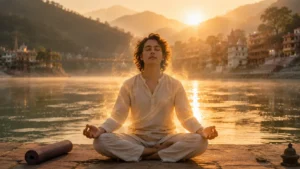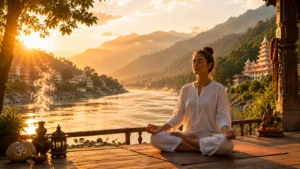


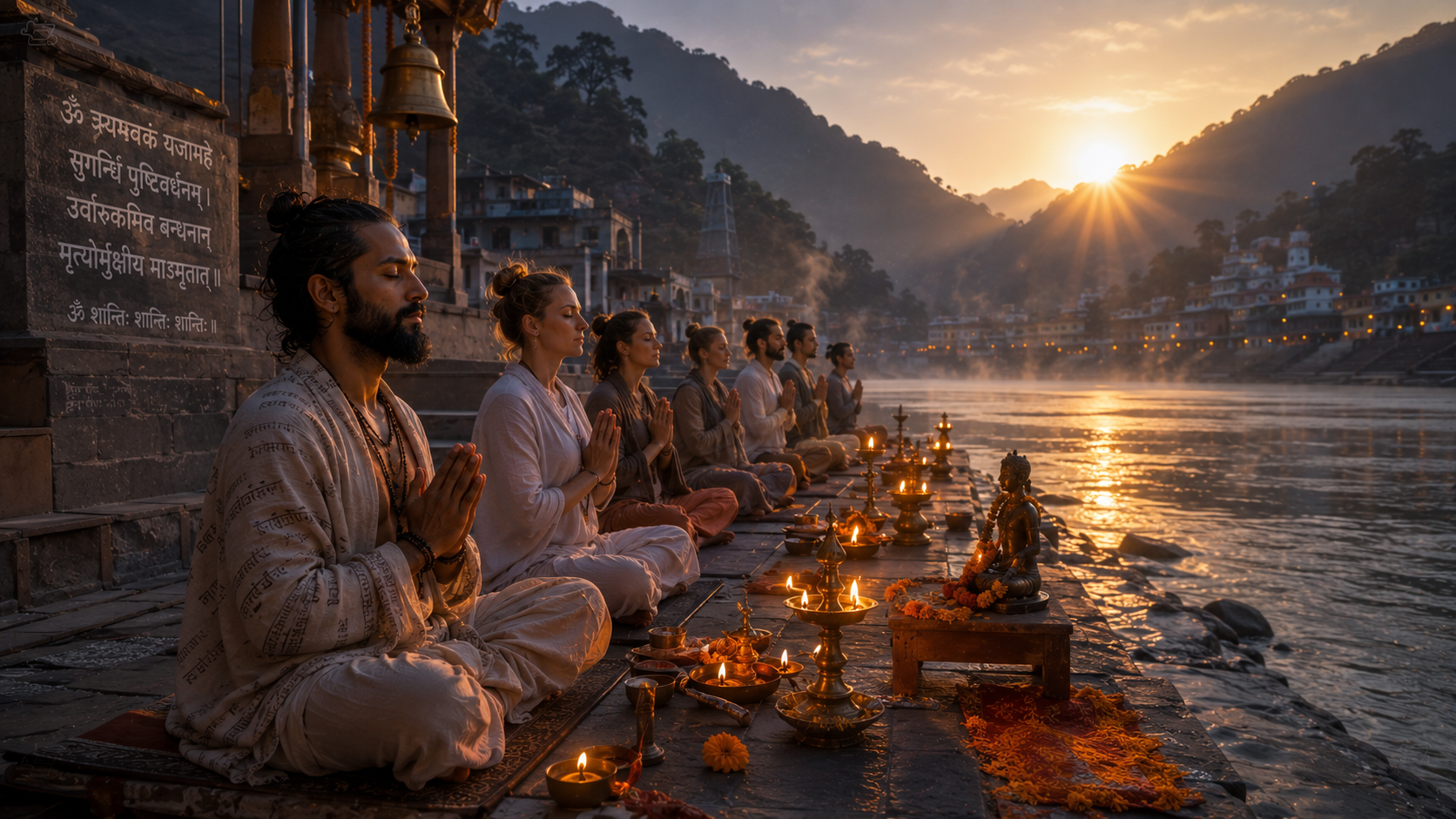
The Mahamrityunjaya mantra meaning and benefits are known in yoga schools across the world. But something specific happens when this mantra is chanted in Rishikesh — in a practice hall that faces the Ganga, before sunrise, with a teacher who carries a living lineage behind every syllable. The sound lands differently here.
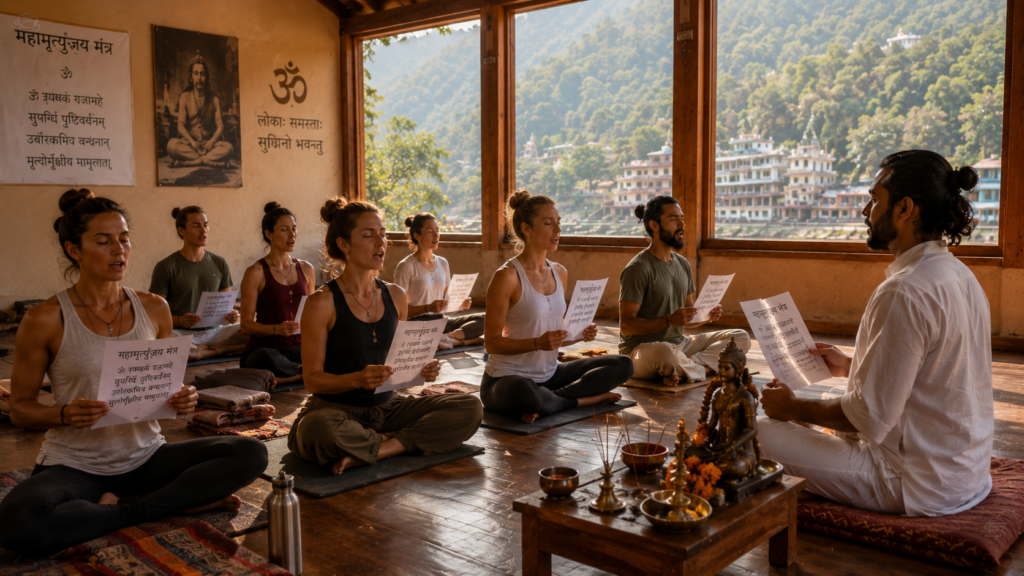
At Triyambakam Yoga Centre in Tapovan, the Mahamrityunjaya mantra meaning and benefits are not taught as information to be memorised. They are given as direct experience. Morning after morning, students sit together in the pre-dawn quiet and let this 32-syllable verse from the Rigveda move through the body. Something in the body recognises it — often before the mind has fully processed what each word means. This recognition is the real beginning of the practice, and it is the reason students travel from over 70 countries to receive this teaching at its source.
The Mahamrityunjaya Mantra — Full Text
Before exploring the Mahamrityunjaya mantra meaning and benefits in depth, the mantra itself must sit at the centre. This is the complete Sanskrit text with transliteration:
ॐ त्र्यम्बकं यजामहे सुगन्धिं पुष्टिवर्धनम्
उर्वारुकमिव बन्धनान्मृत्योर्मुक्षीय माऽमृतात् ॥
Om Tryambakam Yajamahe Sugandhim Pushtivardhanam
Urvarukamiva Bandhanan Mrityor Mukshiya Maamritat
The overall translation of the Mahamrityunjaya mantra meaning and benefits tradition reads: “We worship the three-eyed Lord Shiva, who is fragrant and who nourishes all beings. May He liberate us from death — as the cucumber releases from its vine — without separating us from immortality.” Each word in the Mahamrityunjaya mantra meaning and benefits carries a precise Sanskrit meaning, and together they form a complete statement about the self, about death, and about what liberation actually is.
Mahamrityunjaya Mantra Meaning — Word by Word
| Sanskrit Word | Transliteration | Literal Meaning | Deeper Significance |
| ॐ | Om | The primordial sound | The vibration from which all creation arises |
| त्र्यम्बकं | Tryambakam | The three-eyed one | Lord Shiva — past, present, and future vision |
| यजामहे | Yajamahe | We worship / we honour | Collective devotion — not individual petition |
| सुगन्धिं | Sugandhim | Fragrant / the sweet-smelling one | The one whose presence purifies everything around |
| पुष्टिवर्धनम् | Pushtivardhanam | The nourisher of all beings | Shiva as the sustainer of life and vitality |
| उर्वारुकमिव | Urvarukamiva | Like the cucumber from its vine | Natural, effortless release from bondage |
| बन्धनात् | Bandhanan | From bondage / attachment | The chains of ego, fear, and illusion |
| मृत्योर्मुक्षीय | Mrityor Mukshiya | Liberate me from death | Freedom from the cycle of birth and death |
| माऽमृतात् | Maamritat | Not from immortality | Do not separate me from the eternal self |
The cucumber metaphor — urvarukamiva — sits at the philosophical heart of the Mahamrityunjaya mantra meaning and benefits. A ripe cucumber releases from its vine on its own — without force, without struggle, without pain. This single image holds the whole teaching of the Mahamrityunjaya mantra meaning and benefits.
The mantra does not ask for a dramatic escape from life. It asks for that same natural ripening — the gentle release of the soul from its temporary identification with the mortal body, when the time is right. This is a mature and unusually precise spiritual vision. It is not a plea to avoid death but a prayer to meet it without fear, fully ripened, ready. Everything that the Mahamrityunjaya mantra meaning and benefits offer rests on this single image.
The Origin and History of the Mahamrityunjaya Mantra
The Mahamrityunjaya mantra meaning and benefits cannot be fully appreciated without the story of Markandeya. He was a young sage born to parents who, when offered the choice, had chosen a brilliant but short-lived child over a long-lived but ordinary one. His father kept the prophecy of an early death hidden from him as long as he could.
When Markandeya reached sixteen — the year he was destined to die — Yama, the lord of death, came for him. The boy ran to the temple, wrapped his arms around the Shivalingam, and chanted this mantra with complete surrender. Lord Shiva emerged from the lingam, confronted Yama directly, and granted the boy not just his life but immortality itself. The Mahamrityunjaya mantra meaning and benefits were, in this telling, born from that single act of grace.
What matters in the story is the mechanism. The young sage did not escape death through magic or bargaining. He escaped it through the complete dissolution of fear — through a surrender so total that there was nothing left for death to take hold of. This is the spiritual logic behind the Mahamrityunjaya mantra meaning and benefits: liberation that makes death itself irrelevant, because what dies was never the true self in the first place. Understanding this turns the Mahamrityunjaya mantra meaning and benefits from a recitation into a real practice.
The verse appears in three Vedic texts — the Rigveda (7.59.12), the Yajurveda, and the Atharvaveda — making it one of the most universally endorsed mantras in the entire Vedic canon. It is also called the Rudra Mantra and the Tryambakam Mantra. That second name resonates directly with Triyambakam Yoga Centre, whose own name is drawn from the mantra’s opening word — meaning the Mahamrityunjaya mantra meaning and benefits are not borrowed here from an outside tradition, but sit at the living centre of what this place was founded to carry.
Mahamrityunjaya Mantra Meaning and Benefits — Across All Dimensions
The Mahamrityunjaya mantra meaning and benefits are not confined to one layer of the human system. They reach the physical body, the mind, the energetic field, and the spirit — each through a distinct mechanism, as the table below sets out.
| Dimension | Mahamrityunjaya Mantra Benefit | How It Works |
| Physical | Healing and immunity support | Sound vibrations activate Manipura chakra and strengthen pranic energy throughout the body |
| Physical | Reduced blood pressure and heart rate | Rhythmic chanting calms the autonomic nervous system — measurable in clinical observation |
| Mental | Reduction of anxiety and fear | Mantra vibration reduces cortisol and creates inner coherence between breath and thought |
| Mental | Sharper focus and concentration | Activates the frontal cortex — the region associated with clarity and higher awareness |
| Energetic | Purification of the nadis | 32-syllable vibration realigns disturbances in the pranic body’s vibratory field |
| Energetic | Chakra activation — Manipura and Ajna | Specific syllables correspond to specific chakra frequencies in Tantric science |
| Spiritual | Release from fear of death | Mantra meaning directly addresses the eternal nature of the self — not the mortal body |
| Spiritual | Movement toward moksha | Repeated meditation on the mantra dissolves identification with impermanence |
The Physical Benefits of the Mahamrityunjaya Mantra
Among the Mahamrityunjaya mantra meaning and benefits, the physical dimension is the most studied in modern times. Sri Swami Satyananda — one of the great yogic teachers of the twentieth century — explained that the mantra’s syllables create specific vibrations that realign disturbances in the body’s pranic field. In the yogic view, disease begins as an imbalance in prana, the life force, long before it ever manifests in physical tissue. The mantra works at that earlier, subtler level.
The Mahamrityunjaya mantra meaning and benefits on the physical level work primarily by restoring pranic balance — particularly in the Manipura chakra, the solar plexus centre that governs vitality, digestion, and the immune response. When this centre is strong and the prana flows freely, the body’s own healing capacity is supported from within.
There is measurable evidence behind these claims. Clinical observations have recorded reductions in blood pressure and heart rate in regular practitioners. A study at Ram Manohar Lohia Hospital in Delhi found that coma patients with severe brain trauma showed significantly higher survival rates when the mantra was chanted in their environment. And a 2007 experiment at the Quantum Scio Conference in Madrid recorded positive effects on both practitioners and bystanders — confirming that the Mahamrityunjaya mantra meaning and benefits reach even those who are simply present in the room where the vibration occurs.
The Mental and Emotional Benefits of the Mahamrityunjaya Mantra
The Mahamrityunjaya mantra meaning and benefits on the mental and emotional level are just as well documented. Rhythmic chanting reduces cortisol, the primary stress hormone, and creates a state of inner coherence between the breath, the nervous system, and the activity of the mind. The mantra also activates the frontal cortex — the brain region tied to focus, memory, and higher-order thinking. Practitioners consistently report sharper concentration and far calmer responses to difficulty.
The emotional benefits matter most for those moving through grief, illness, or sustained fear. The mantra does not suppress emotion — that is not its function. It does something more useful: it builds a container of vibration and stillness strong enough that even intense emotions can be felt from a place of inner stability instead of overwhelm. This is one of the most valued of all the Mahamrityunjaya mantra meaning and benefits.
At Triyambakam Yoga Centre, students who arrive carrying grief or burnout often name the morning mantra practice as the place where something first begins to shift. Not because the problems vanish, but because the relationship with them changes. This is precisely how the tradition always described the Mahamrityunjaya mantra meaning and benefits — working quietly, from the inside out, until the practitioner notices one day that the weight they carried has loosened its grip.
How to Chant the Mahamrityunjaya Mantra Correctly
The Mahamrityunjaya mantra meaning and benefits are magnified when the chanting is done with correct pronunciation, an appropriate posture, and a clear sankalpa — a conscious intention set before the practice begins.
The mantra is 32 syllables, and each one has a specific place of articulation in the mouth and throat. Incorrect pronunciation does not make the practice harmful, but correct pronunciation draws out the full vibrational effect. This is why, at Triyambakam, students in every programme receive dedicated instruction in Sanskrit phonetics as part of the curriculum — the sound is taught as carefully as the meaning.
| Aspect | Traditional Guidance | At Triyambakam |
| Best Time | Brahma Muhurta — 1.5 hours before sunrise | 5:30 AM — before the Hatha yoga morning session |
| Repetitions | 108 times with Rudraksha mala; minimum 11 times | Taught as part of daily mantra sadhana in all programmes |
| Posture | Seated — Sukhasana or Padmasana | Seated with spine erect; same posture as pranayama practice |
| Mala | Rudraksha mala — 108 beads | Available at the centre; technique taught in TTC programmes |
| Sankalpa | Set a clear intention before beginning | Intention setting is part of every mantra session at Triyambakam |
| Environment | Clean, quiet space; face east | Practice hall faces the Ganga — Tapovan, Rishikesh |
Mahamrityunjaya Mantra at Triyambakam Yoga Centre, Rishikesh
The Mahamrityunjaya mantra meaning and benefits take on a particular quality in Rishikesh — a city where this mantra has been chanted without interruption for longer than any written record can confirm.
At Triyambakam Yoga Centre in Tapovan, the Ganga flows within walking distance of the practice hall. The mountain air is clear and thin. The evenings carry the sound of aarti bells drifting up from the ghats. When the Mahamrityunjaya mantra meaning and benefits are taught in this setting, they do not arrive as new information. They arrive as something the body seems to already know — the way a familiar scent can recall a memory that predates words.
Students who have chanted this mantra at Triyambakam — in the pre-dawn dark, with the river audible through the open hall — consistently describe the experience as different in kind from chanting it in an urban studio. The benefits of the mantra are the same wherever it is sounded. But in Rishikesh, at the source, every condition that allows those benefits to land most deeply happens to be present at once: the place, the time, the lineage, and the river.
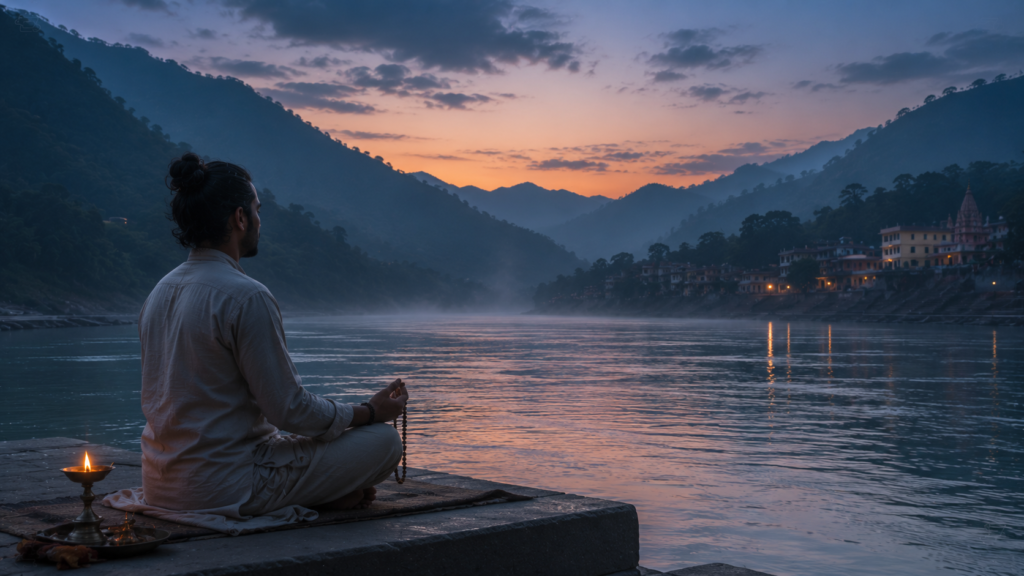
Prof. Anamika brings the Shakti lineage to the teaching in a way that makes the Mahamrityunjaya mantra meaning and benefits accessible even to students with no prior Sanskrit or mantra background. The teaching moves in a deliberate order — from meaning, to sound, to felt experience — so that by the time a student is chanting freely, they understand exactly what they are invoking and why.
Mahamrityunjaya Mantra in Triyambakam Programmes
Across every programme at the centre, the Mahamrityunjaya mantra meaning and benefits are integrated into daily practice rather than treated as an isolated lesson. The table below shows how the mantra appears in each offering.
| Programme | How Mantra Is Used | What Students Learn |
| 200-Hour Hatha Yoga TTC | Daily morning chanting + philosophy class | Mantra meaning, Sanskrit pronunciation, lineage context |
| 300-Hour Advanced TTC | Full mantra sadhana as daily practice | Kriya integration, chakra correspondence, teaching method |
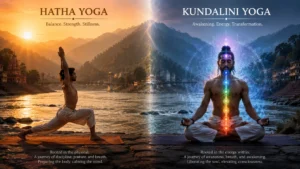
| Kundalini Awakening Programme | Mantra as active energetic tool in kriyas | Vibrational effects on the energy body — direct experience |
| Yoga Retreat (7 & 14 Day) | Evening kirtan and mantra near the Ganga | Meditative experience of mantra sound in sacred environment |
Mahamrityunjaya Mantra and the Yoga Retreat in Rishikesh
For those who come to Rishikesh for rest and inner work rather than formal training, the Mahamrityunjaya mantra meaning and benefits form a central part of the evening practice.
In the Yoga Retreat in Rishikesh programmes at Triyambakam, the evening session near the Ganga includes kirtan and group mantra chanting, and the Mahamrityunjaya mantra is among the primary mantras used. Participants who have never chanted before find that group practice makes the Mahamrityunjaya mantra meaning and benefits immediately accessible — the collective vibration of many voices carries the newcomer along in a way that solo practice can take months to reach.
Sitting beside the Ganga at dusk, in the natural quiet of Tapovan, the Mahamrityunjaya mantra meaning and benefits reach layers of the nervous system that ordinary daily life keeps perpetually switched on. The stress the body has been holding for months begins, slowly, to release. The mantra does not require belief to do this. It requires only the willingness to sit, to sound the syllables, and to listen to what the body says in the silence that follows. In that silence, the Mahamrityunjaya mantra meaning and benefits do their deepest work.
Frequently Asked Questions About Mahamrityunjaya Mantra Meaning and Benefits
A few questions come up repeatedly from students new to the Mahamrityunjaya mantra meaning and benefits. The answers below reflect both the classical guidance and how the practice is taught at Triyambakam.
How many times should the mantra be chanted daily to access the Mahamrityunjaya mantra meaning and benefits? The traditional number is 108 repetitions with a Rudraksha mala, though even 11 repetitions done with full attention and a clear sankalpa produce real results. A practice of 21 repetitions every morning, held for 40 days, is the classical threshold for the effects to stabilise in the system. Consistency matters far more than quantity.
Can the Mahamrityunjaya mantra meaning and benefits be received by listening alone, without chanting? Yes. Both the ancient teachers and modern research confirm that the vibrational field of the mantra benefits even those who are simply present in its environment. Active chanting with intention is more potent — but listening is never without effect.
Does one need to be Hindu to practise the Mahamrityunjaya mantra meaning and benefits? No. In the Tantric and yogic tradition, Lord Shiva is not a sectarian deity but the principle of consciousness itself — the awareness that witnesses all phenomena without being disturbed by any of them. The Mahamrityunjaya mantra meaning and benefits are available to any sincere practitioner, regardless of background, who approaches the practice with correct pronunciation and a settled mind.
The Mantra That Lives in the Name Itself
Triyambakam Yoga Centre takes its name directly from the opening word of the Mahamrityunjaya mantra — Tryambakam, the three-eyed one. This is not branding. It is a statement of lineage and of intention.
The Mahamrityunjaya mantra meaning and benefits are woven into the founding purpose of this centre, and every programme, retreat, and teaching that happens here carries that current. Students who chant the mantra at Triyambakam are chanting it in the very place whose name invokes it — beside the river the tradition reveres, in the mountains the tradition calls the abode of Shiva himself. Nowhere else are the Mahamrityunjaya mantra meaning and benefits held so close to their origin.
The Mahamrityunjaya mantra meaning and benefits are as alive now as they were when Markandeya sat in the temple and let the syllables carry him through his fear. To begin your own practice, contact Triyambakam Yoga Centre at +91 8006335555 or through the contact form on this website. The centre is located near Lakshman Jhula, Tapovan, Rishikesh, Uttarakhand 249192.