

The difference between Hatha and Kundalini yoga is one of the first questions every serious student asks at Triyambakam Yoga Centre in Rishikesh. Both styles appear on the timetable. Both carry Sanskrit names that have been used for centuries. Both come from the same ancient Indian tradition. Yet when a practitioner sits through a Hatha session in the morning and then steps into a Kundalini session in the evening, they encounter two experiences so distinct in feel, pace, and effect that calling them by the same word — yoga — seems almost insufficient. Understanding the difference between Hatha and Kundalini yoga is not an academic exercise. It is practical knowledge that shapes how you practise, what you choose to study, and what happens in your body, breath, and mind over time.
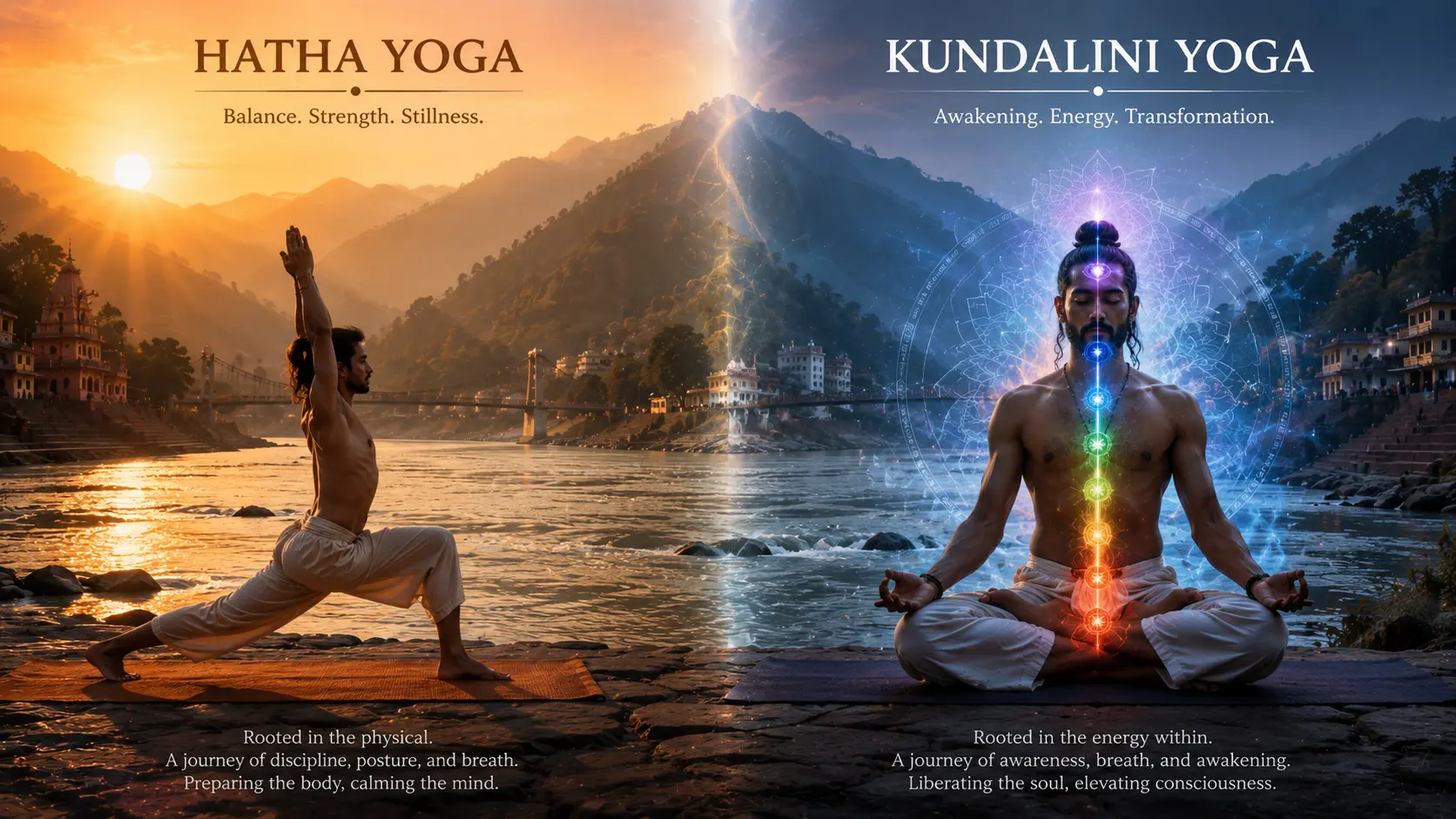
The difference between Hatha and Kundalini yoga is not simply physical versus spiritual. That framing flattens both traditions and misrepresents what each actually does. Hatha yoga works with the physical body, yes — but its ultimate aim is spiritual. Kundalini yoga activates energy, yes — but it also works intensely on the physical nervous system. The difference between Hatha and Kundalini yoga is better described as a difference in primary instrument: Hatha uses form, Kundalini uses fire. At Triyambakam Yoga Centre, where both traditions are taught within a single integrated lineage under Prof. Anamika, students have the rare opportunity to feel this difference directly — not as theory but as lived experience on the mat.
The Roots: Where Each Tradition Comes From
To truly grasp the difference between Hatha and Kundalini yoga, one must go back to the source texts. Hatha yoga is codified most fully in the Hatha Yoga Pradipika, written by Swami Swatmarama in the 15th century. The word Hatha itself — Ha meaning sun, Tha meaning moon — describes the central purpose: the union of opposing energies within the human system. The solar and lunar, the active and receptive, the outward and the inward. Hatha yoga works through asana (posture), pranayama (breath regulation), shatkarma (internal cleansing), mudra (energetic gesture), and bandha (energy lock) to purify the physical and subtle body. The physical body is the primary field of operation. By mastering it, the practitioner clears the conditions for the mind to become still.
Kundalini yoga draws from the Tantric tradition — a body of knowledge that predates and encompasses Hatha yoga. Where the difference between Hatha and Kundalini yoga becomes most obvious at the root level is in the locus of operation. Hatha works on the physical body to prepare the energetic body. Kundalini works directly on the energetic body — specifically on the Kundalini Shakti, the coiled energy believed to rest dormant at the base of the spine at the Muladhara chakra. The entire project of Kundalini yoga is to awaken this energy and guide it upward through the Sushumna nadi, the central energy channel, through each of the seven chakras until it reaches the Sahasrara at the crown. Asana is one tool among many. Mantra, kriya, mudra, pranayama, and meditation carry equal or greater weight. The difference between Hatha and Kundalini yoga, at this foundational level, is the difference between preparation and activation.
Difference Between Hatha and Kundalini Yoga: Core Comparison
| Feature | Hatha Yoga | Kundalini Yoga |
| Primary Focus | Physical body — asanas, alignment, flexibility | Energy body — chakras, prana, awakening |
| Pace | Slow, steady, held postures | Dynamic, rhythmic, repetitive movements |
| Breathwork | Ujjayi breath, natural breathing | Breath of fire, alternate nostril, precise counts |
| Mantra & Chanting | Optional — used occasionally | Central to every session |
| Session Structure | Teacher has creative freedom in sequencing | Fixed kriyas — numerically precise sets |
| Best Suited For | Beginners, physical health, stress relief | Spiritual seekers, emotional release, chakra work |
| Intensity | Gentle to moderate | Moderate to intense — energetically and emotionally |
What Happens in a Hatha Yoga Class at Triyambakam
When you sit in a Hatha yoga class at Triyambakam Yoga Centre in Rishikesh, the first thing you notice is the quality of stillness. The session opens with seated pranayama — usually three-part breathing or nadi shodhana, the alternate nostril breath — drawing the attention inward and settling the nervous system. The difference between Hatha and Kundalini yoga is felt immediately: Hatha asks you to slow down. The asana sequence that follows works the spine in all directions — forward folds, backbends, lateral stretches, twists, inversions. Each posture is held long enough for the body to genuinely release rather than simply arrive at the shape.
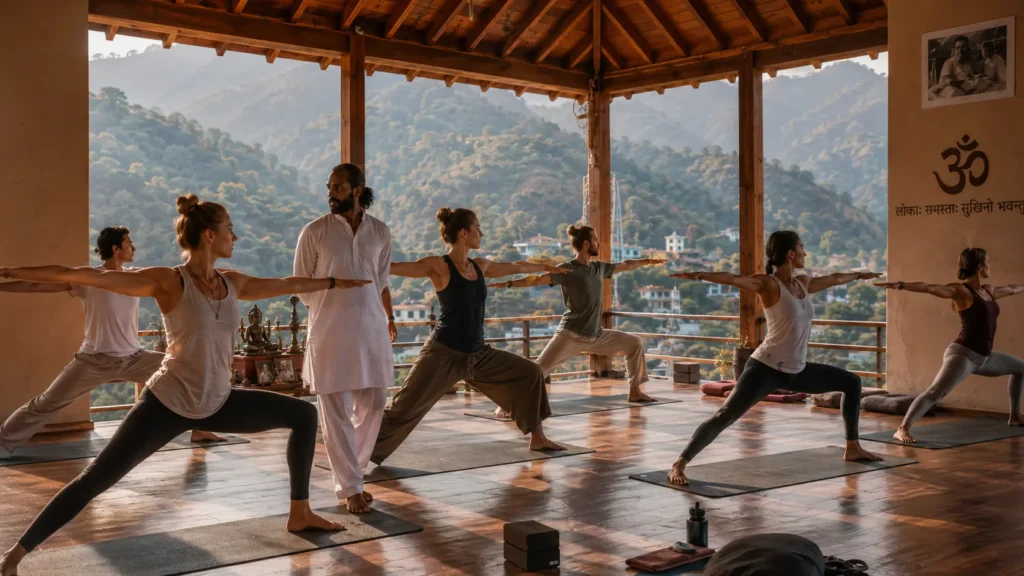
The holding is where the real work of Hatha yoga happens. Muscles gripped by habitual tension are given time to let go. The nervous system learns that stillness is safe. The breath, sustained consciously through held postures, moves prana into areas of the body where it has been blocked. A well-sequenced Hatha class leaves the practitioner not tired but released — the body lighter, the breath more spacious, the mind quieter. This is the signature effect of Hatha yoga and one of the clearest ways to feel the difference between Hatha and Kundalini yoga in the body: Hatha produces a profound physical quieting.
What Happens in a Kundalini Yoga Class at Triyambakam
Step into a Kundalini session and the atmosphere shifts immediately. This is where the difference between Hatha and Kundalini yoga is most visceral. Where Hatha is measured and quiet, Kundalini is alive with sound, breath, and movement. The session opens with the Adi Mantra — Ong Namo Guru Dev Namo — chanted three times to tune the practitioner into the lineage. From there, the class moves into a kriya: a precisely structured set of exercises designed to produce a specific energetic outcome.
A kriya might involve rapid repetitive arm movements coordinated with Breath of Fire — the powerful diaphragmatic breath that generates intense internal heat and moves prana at speed. Or it might mean holding a posture at a precise angle for seven to eleven minutes while sustaining a breath pattern and silently repeating a mantra. The precision of Kundalini kriyas is not arbitrary — each element has been transmitted through the lineage with exact specifications because the combination produces a specific effect on the nervous system and energetic body. After the active kriya, the session moves into deep meditation. This is the moment where the difference between Hatha and Kundalini yoga registers most powerfully for many practitioners: the states of stillness, clarity, or emotional release that follow a Kundalini kriya are often unlike anything a purely physical practice produces.
The Difference Between Hatha and Kundalini Yoga in Breathwork
Breath is where the difference between Hatha and Kundalini yoga is most immediately felt in the body. In Hatha yoga, the primary breath used during asana is Ujjayi — the victorious breath, created by slightly constricting the back of the throat to produce a soft, ocean-like sound on both inhale and exhale. Ujjayi breath is steady, rhythmic, deeply calming, and keeps the nervous system regulated throughout the practice. It maintains internal heat, anchors attention in the present moment, and makes the breath audible so the practitioner can monitor it continuously.
Kundalini yoga uses a far wider and more powerful range of pranayama. The most distinctive is Breath of Fire — rapid, rhythmic, diaphragmatic breathing through the nose where both inhale and exhale are active and equal. Where Ujjayi is a steady river, Breath of Fire is a bellows. It rapidly oxygenates the blood, stimulates the solar plexus chakra, generates intense internal heat, and moves prana with a force that practitioners describe as immediately perceptible in the body. Sustained for several minutes within a kriya, it can produce states of altered awareness and deep energetic activation. To feel the difference between Hatha and Kundalini yoga in the breath alone is to feel two completely different instruments playing within the same human body.
Chakra Work: How Each Tradition Approaches the Energy Centres
Both Hatha and Kundalini yoga work with the chakra system, and this is another dimension of the difference between Hatha and Kundalini yoga that practitioners at Triyambakam come to feel directly over time. Hatha yoga approaches the chakras primarily through the physical body — specific asanas are known to stimulate and open particular energy centres. Kundalini yoga works with the chakras directly through kriyas, mantras, and breathwork designed to move the Kundalini Shakti through each centre in sequence.
| Chakra | Sanskrit Name | Hatha Yoga Method | Kundalini Yoga Method |
| Root | Muladhara | Grounding asanas — Tadasana, Malasana | Root lock (Mula Bandha), earth kriyas |
| Sacral | Svadhisthana | Hip openers — Baddha Konasana, Upavishtha | Frog pose kriya, water element breathwork |
| Solar Plexus | Manipura | Core work — Navasana, Ardha Matsyendrasana | Breath of fire, Uddiyana Bandha |
| Heart | Anahata | Backbends — Bhujangasana, Ustrasana | Compassion kriyas, green light meditation |
| Throat | Vishuddha | Shoulderstand, fish pose, neck lengthening | Mantra chanting, neck rolls, sound vibration |
| Third Eye | Ajna | Trataka, inversion poses | Shambhavi mudra, third eye meditation |
| Crown | Sahasrara | Sirsasana (headstand), deep Savasana | Sat Nam mantra, full awakening kriyas |
The Role of Mantra in the Difference Between Hatha and Kundalini Yoga
Mantra is another clear marker of the difference between Hatha and Kundalini yoga. In Hatha yoga, mantra has a place — the session may open with Om chanting or a Vedic invocation — but it is not a structural element of the practice itself. The asanas, breath, and alignment carry the session. In Kundalini yoga, mantra is inseparable from everything that happens. It is woven into the kriyas, repeated silently during postures in coordination with the breath, chanted aloud as part of the session structure, and used during meditation as the primary vehicle for entering deeper states.
The logic of mantra in Kundalini yoga is that specific sound vibrations — particular frequencies corresponding to particular states of consciousness — work directly on the nervous system and energy body in ways that asana alone cannot reach. At Triyambakam, where Prof. Anamika’s background spans both the classical Hatha tradition and the Shakti-Kundalini lineage, mantra is taught with this understanding behind it. Students who have only encountered mantra as ambient sound in a studio class frequently say that receiving it in this context brings the difference between Hatha and Kundalini yoga into sharp focus — because suddenly one of the tools that seemed decorative reveals itself as something else entirely.
Which to Practise — Choosing Based on Your Goals
| Your Goal | Recommended Practice | Why |
| Build physical strength & flexibility | Hatha Yoga | Slow held postures build muscular endurance and joint mobility |
| Reduce stress and anxiety | Hatha Yoga | Steady breath and posture activate parasympathetic nervous system |
| Spiritual awakening | Kundalini Yoga | Kriyas and mantra directly work on the energetic body |
| Emotional release and healing | Kundalini Yoga | Breathwork and specific kriyas move stored emotional energy |
| Complete beginner to yoga | Hatha Yoga first | Foundational postures and alignment before energetic work |
| Deepen meditation practice | Both — sequentially | Hatha prepares the body; Kundalini opens the channels |
| Chronic fatigue or low energy | Kundalini Yoga | Breathwork and kriyas recharge the nervous system rapidly |
Can Hatha and Kundalini Yoga Be Practised Together
Many students at Triyambakam do exactly this. The morning session is Hatha — a thorough physical practice that works every part of the body and establishes clear breath awareness. The evening session is Kundalini — a specific kriya set followed by deep meditation. The difference between Hatha and Kundalini yoga does not create a conflict when both are practised together. In the classical view, they are sequential stages of the same process. Hatha is sometimes described as the outer form and Kundalini as the inner fire. Practise both consistently and they reinforce each other in ways that neither achieves alone.
Students in the Triyambakam Teacher Training programmes experience this integration from the first week. The curriculum does not treat the difference between Hatha and Kundalini yoga as a reason to separate them. It teaches them as aspects of a single continuous practice — which is precisely how they existed in the classical tradition long before the modern wellness industry packaged them as two distinct commercial offerings. For those who want to experience both within a dedicated immersive setting, a Yoga Retreat in Rishikesh at Triyambakam offers exactly this — a structured schedule in which both Hatha and Kundalini practice are woven into each day.
How Triyambakam Yoga Centre Teaches Both Traditions
Triyambakam Yoga Centre in Rishikesh is among the very few spaces where both sides of the difference between Hatha and Kundalini yoga are held within a single coherent lineage. Most centres specialise in one tradition. At Triyambakam, under the guidance of Prof. Anamika — whose training spans the classical Hatha tradition rooted in the Hatha Yoga Pradipika and the Shakti-Kundalini lineage — the two are taught as a unified body of knowledge. Students come away not with two separate systems but with one integrated practice that draws on the full depth of both.
| Aspect | Hatha at Triyambakam | Kundalini at Triyambakam |
| Morning Practice | Classical asana with alignment focus | Kriya sets and pranayama sequences |
| Teacher Lineage | Classical Hatha — Hatha Yoga Pradipika | Tantric and Shakti lineage under Prof. Anamika |
| Mantra Use | Vedic chants at session opening | Mantra woven through the entire session |
| Duration | 60–90 minutes, held postures | 60–75 minutes, active kriya sets |
| Who Joins | All levels including complete beginners | Practitioners with some yoga base |
What the Classical Texts Say About the Difference Between Hatha and Kundalini Yoga
The Hatha Yoga Pradipika states explicitly that the entire purpose of Hatha yoga is to prepare for Raja yoga — the yoga of the mind. Asana steadies the body. Pranayama steadies the breath. Both steady the mind. From a still mind, deeper states become accessible. This is where the difference between Hatha and Kundalini yoga at the textual level becomes nuanced: the Hatha Yoga Pradipika describes Hatha as preparatory, while the Tantric texts describe Kundalini as the activation that Hatha prepares for. They are not competing systems in the classical view. They are stages.
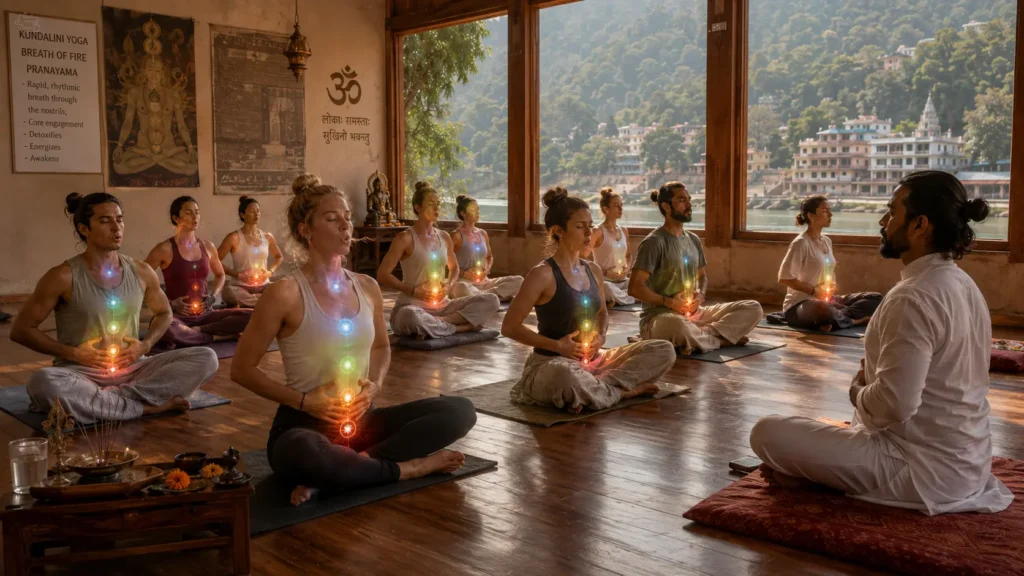
The Tantric texts describe the Kundalini Shakti as the dormant feminine energy coiled at the base of the spine. When Hatha yoga has sufficiently purified the nadis and the physical body, the conditions are right for Kundalini to rise through the Sushumna — through each chakra, dissolving the knots (granthis) at the heart, the throat, and the crown — until it unites with Shiva consciousness at the Sahasrara. This is the map that makes sense of the difference between Hatha and Kundalini yoga: Hatha clears the road. Kundalini makes the journey.
Frequently Asked Questions About the Difference Between Hatha and Kundalini Yoga
Is Kundalini yoga dangerous for beginners? The difference between Hatha and Kundalini yoga includes a difference in intensity — and Kundalini practice is powerful. It is not dangerous when practised under qualified guidance, but it deserves respect. At Triyambakam, students with no prior yoga experience begin with Hatha practice and are introduced to Kundalini kriyas gradually. This is the correct approach from a classical standpoint and reflects how the two traditions are meant to work together.
How quickly are results felt? Most people feel the physical effects of Hatha yoga within the first week — better sleep, reduced physical tension, increased body awareness. The effects of Kundalini practice can arrive within a single session: strong emotional release, a sharp sense of energy moving through the body, unusually deep meditative states. The difference between Hatha and Kundalini yoga in terms of immediate felt effect is that Kundalini tends to work faster and more intensely on the energetic and emotional levels, while Hatha works more gradually and reliably on the physical and nervous system.
Can I practise both during the same programme? Yes. The 200-hour and 300-hour Teacher Training programmes at Triyambakam Yoga Centre cover both sides of the difference between Hatha and Kundalini yoga within a single integrated curriculum. Students graduate with theoretical knowledge and practical hours in both traditions, making the Triyambakam certification among the most complete available in Rishikesh.
Does the difference between Hatha and Kundalini yoga mean I have to choose one permanently? No. The classical tradition does not ask this. Many of the most accomplished practitioners at Triyambakam maintain a daily practice that draws on both — Hatha in the morning to work the body, Kundalini in the evening to work the energy. The two traditions, when practised with consistency and proper guidance, produce a combined effect that is greater than either achieves alone.
Two Roads Into the Same Silence
The difference between Hatha and Kundalini yoga is real, significant, and worth knowing before stepping onto the mat. Hatha works through form — precise placement of the body, long held breath, the slow unwinding of physical tension layer by layer. Kundalini works through fire — the ignition of breath, the vibration of mantra, the deliberate awakening of what has been sleeping at the base of the spine. Both are authentic. Both are ancient. Both produce results that practitioners carry far beyond the practice session itself.
The difference between Hatha and Kundalini yoga is ultimately a difference of emphasis and instrument, not of destination. Both traditions, practised authentically and consistently, lead toward the same inner stillness — the state in which the practitioner stops identifying with the noise of the mind and rests in awareness itself. Hatha takes the road through the body. Kundalini takes the road through energy. In Rishikesh, at Triyambakam Yoga Centre in Tapovan where both roads are known and taught within a single living lineage, no practitioner has to choose just one path.
To experience the difference between Hatha and Kundalini yoga in person, Triyambakam Yoga Centre offers a free one-week trial class for new students. Teacher Training dates, retreat programmes, and Kundalini Awakening intensives are available throughout the year. Reach the centre at +91 8006335555 or through the contact form on this website. Triyambakam Yoga Centre is located near Lakshman Jhula, Tapovan, Rishikesh, Uttarakhand 249192.