
The evidence for yoga for anxiety and depression has been building for decades. A 2024 meta-analysis published in the journal Depression and Anxiety analysed randomised controlled trials and found significant improvements in both conditions — with effect sizes comparable to those of conventional therapeutic interventions. A 2025 study from the All India Institute of Medical Sciences recorded standard mean differences of -1.54 for depression and -1.56 for anxiety in yoga practitioners compared to control groups. Harvard Medical School research showed that yoga for anxiety and depression works partly by elevating GABA — a brain chemical associated with better mood and decreased anxiety — through the same pathway targeted by anti-anxiety medication, but without the side effects.
What the science confirms, the classical yogic tradition had already mapped in precise detail. The ancient teachers did not use the language of cortisol and neurotransmitters — they used the language of prana, nadis, and the vrittis of the mind. But the observation was the same: a specific combination of asana, pranayama, and meditation, practised consistently over time, changes the baseline state of the nervous system. Yoga for anxiety and depression is not a new discovery. It is an ancient technology being verified by modern measurement. At Triyambakam Yoga Centre in Rishikesh, this technology is taught in its most complete and classical form.
How Yoga for Anxiety and Depression Works in the Body
Most people who begin yoga for anxiety and depression want to know the mechanism — what is actually happening physiologically when the practice works. The answer operates on multiple levels simultaneously, which is one reason yoga tends to be more durable in its effects than interventions that target only one pathway.
At the neurological level, yoga for anxiety and depression works primarily through three mechanisms. First, it activates the parasympathetic nervous system — the rest-and-digest state that anxiety and depression both suppress. Second, it reduces cortisol, the primary stress hormone, which when chronically elevated damages the hippocampus and contributes directly to both conditions. Third, it elevates GABA, the inhibitory neurotransmitter that calms overactive neural firing. MRI studies have shown that people who practise yoga regularly develop a thicker cerebral cortex and larger hippocampus — the very brain regions that chronic anxiety and depression shrink.
| Mechanism | Effect on Anxiety | Effect on Depression |
| Cortisol Reduction | Lowers the stress hormone that keeps the nervous system in alert mode | Reduces the inflammatory response linked to depressive episodes |
| GABA Elevation | Calms overactive neural firing — same pathway as anti-anxiety medication | Improves mood stability and reduces emotional reactivity |
| Parasympathetic Activation | Switches the body out of fight-or-flight into rest-and-digest | Restores energy levels depleted by chronic low-level stress |
| Hippocampus Support | Reduces amygdala hyperactivity — the fear and threat centre | Increases hippocampal volume — the area shrunk by chronic depression |
| Breath Regulation | Slow breathing directly signals safety to the brain — breaks the panic cycle | Oxygenates the system and lifts the heavy, slowed quality of depressive states |
| Present-Moment Anchoring | Interrupts the forward-projection pattern of anxious thinking | Breaks the backward-dwelling pattern of depressive rumination |
Yoga for Anxiety — The Specific Mechanisms
Anxiety operates primarily through hyperactivation — the nervous system stuck in a state of elevated alert, the breath shallow and fast, the mind projecting future threats that may never arrive. Yoga for anxiety and depression addresses the anxiety dimension most directly through breath regulation and the deliberate slowing of the physiological stress response.
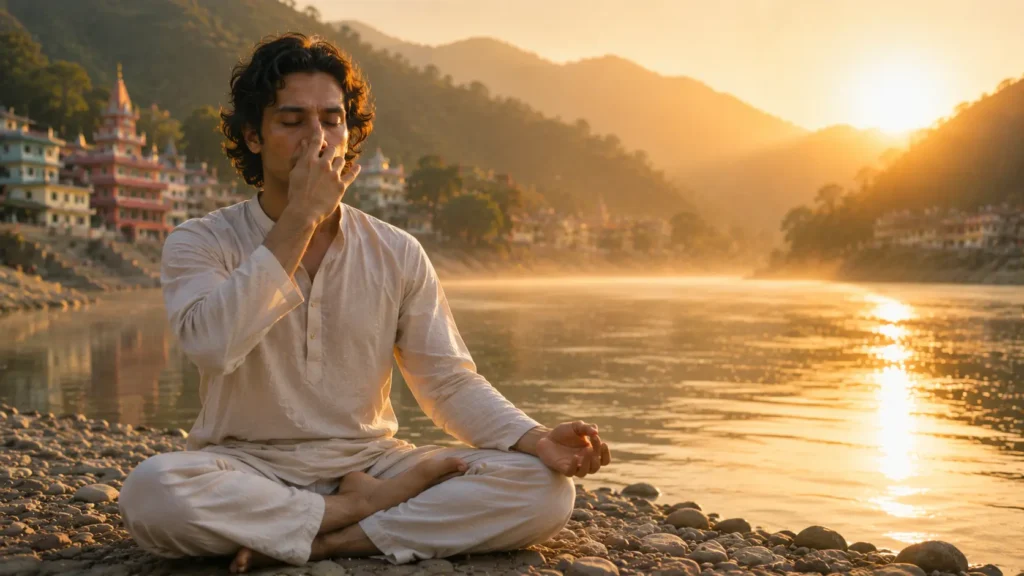
The breath is the fastest route to the autonomic nervous system available without medication. When the exhale is consciously extended beyond the inhale — as in many yoga pranayama practices — the vagus nerve is stimulated and the parasympathetic response is activated within seconds. This is not a relaxation technique in the casual sense. It is a direct physiological intervention — and it is central to why yoga for anxiety and depression works faster than most people expect. Slow, deliberate breathing during the held postures of Hatha yoga produces measurable reductions in heart rate, blood pressure, and cortisol within a single session. For chronic anxiety, yoga for anxiety and depression practised consistently — 3 to 5 sessions per week — produces structural changes in the nervous system over 8 to 12 weeks.
The present-moment anchoring that yoga demands — the sustained attention on breath, sensation, and alignment — also directly interrupts the forward-projection pattern of anxious thinking. Anxiety lives in the future. Yoga lives in the body, in this breath, in this moment. A practitioner who has been inside their head for hours will find, within 20 minutes of a sincere Hatha practice, that the quality of their thinking has changed. Yoga for anxiety and depression does not remove the causes of anxiety — but it changes the practitioner’s relationship with those causes, and that change, sustained over time, is transformative.
Yoga for Depression — The Specific Mechanisms
Depression operates differently from anxiety — not through hyperactivation but through suppression. Energy is low. The body feels heavy. Motivation is absent — these are the defining features that yoga for anxiety and depression must address differently from anxiety. The mind dwells backwards in regret, self-criticism, and a sense of hopelessness that colours everything. Yoga for anxiety and depression addresses the depression dimension through activation — through the specific postures, breath practices, and sounds that lift what has become stuck and heavy in the system.
Backbends are among the most well-documented postures in yoga for anxiety and depression for their direct effect on mood. They open the chest — the physical location where the body contracts in depression — and stimulate the adrenal and thyroid glands. Bridge pose, Bhujangasana (cobra), and Ustrasana (camel) all produce a measurable lift in energy and mood that practitioners notice even from a single session. Studies have found that 20 sessions of yoga produced elevation of mood and reduction of anger and anxiety in participants with major depression. Twice-weekly yoga classes in another study produced significant improvements in depression, anxiety, energy, fatigue, perceived stress, sleep quality, and wellbeing after just three months.
The mantra and chanting elements of yoga for anxiety and depression — particularly as practised in the Kundalini and classical Hatha traditions at Triyambakam — add another dimension that purely asana-based programmes miss. Mantra vibration produces measurable changes in brain wave activity, elevates serotonin, and creates what the yogic tradition describes as a quality of inner fullness that depression specifically depletes. The Mahamrityunjaya mantra, chanted daily at Triyambakam, is among the oldest documented practices for exactly this purpose.
Best Yoga Styles for Anxiety and Depression
| Yoga Style | Best For | Why It Works | Intensity |
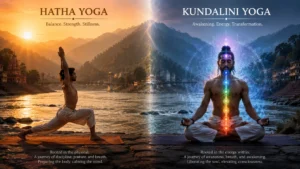
| Hatha Yoga | Both anxiety and depression | Slow-held postures regulate the nervous system and build body awareness | Gentle to moderate |
| Restorative Yoga | Acute anxiety, chronic stress | Supported postures held for extended periods — deep parasympathetic activation | Very gentle |
| Yoga Nidra | Severe anxiety, insomnia, depression | Guided relaxation between waking and sleep — clinically documented for PTSD and depression | Non-active — lying down |
| Pranayama Practice | Panic attacks, chronic anxiety | Breath directly regulates the autonomic nervous system — fastest-acting tool in yoga | Seated — no physical demand |
| Kundalini Yoga | Emotional stagnation, deep depression | Kriyas move stuck emotional energy; mantra provides a sound anchor | Moderate — active kriyas |
| Yin Yoga | Anxiety with physical tension | Long holds release fascia where stress is physically stored — especially hips and spine | Gentle — deep holds |
The Best Yoga Asanas for Anxiety and Depression
The following asanas are among the most consistently recommended in the clinical and classical literature on yoga for anxiety and depression. At Triyambakam Yoga Centre, these postures are taught with precise alignment instruction and breath integration — because the posture alone is only part of the effect. It is the breath within the posture that produces the neurological change.
| Asana | Sanskrit Name | How to Practise | Effect on Anxiety & Depression |
| Child’s Pose | Balasana | Kneel, sit on heels, fold forward, arms extended or beside the body, forehead to floor | Calms the nervous system immediately; reduces anxiety within 2–3 minutes |
| Legs Up the Wall | Viparita Karani | Lie on back, legs vertically up against a wall, arms relaxed, eyes closed, hold 5–10 min | Reverses blood flow, calms the heart, reduces cortisol rapidly |
| Bridge Pose | Setu Bandhasana | Lie on back, knees bent, feet flat, lift hips, clasp hands beneath, hold 30–60 sec | Lifts mood by opening the chest; stimulates the thyroid and adrenal system |
| Forward Fold | Uttanasana | Stand, fold forward from hips, let the head hang heavy, slight bend in knees | Decompresses the nervous system; the inversion calms the mind within seconds |
| Corpse Pose | Savasana | Lie flat, feet apart, palms up, body completely still, minimum 10 minutes | Integrates the practice; allows the nervous system to fully absorb the session |
| Seated Twist | Ardha Matsyendrasana | Sit, one knee up foot flat, opposite elbow outside knee, rotate spine gently each breath | Releases spinal tension where anxiety is held; stimulates the digestive system |
Pranayama — The Fastest-Acting Tool in Yoga for Anxiety and Depression
If asana is the body of the practice, pranayama is the nervous system of yoga for anxiety and depression. Breath regulation works faster than any posture, requires no physical preparation, and can be practised anywhere — including in the middle of an anxiety episode or the deepest point of a depressive day. At Triyambakam, pranayama is taught as a standalone practice, not merely as preparation for asana.
The classical texts identify pranayama as the most direct route to the mind available through the physical body. Where asana works on the gross physical level and meditation works on the mental level, pranayama bridges the two — acting on the nervous system through the breath to produce changes that reach both the body and the mind. For yoga for anxiety and depression, this bridge quality is precisely what makes pranayama so effective: it speaks to both conditions through a single practice.
| Pranayama | Technique | Best For | Duration |
| Nadi Shodhana | Alternate nostril breathing — inhale left, exhale right, inhale right, exhale left | Anxiety, overactive mind, emotional imbalance | 5–10 minutes daily |
| Bhramari | Humming bee breath — inhale fully, exhale with a low hum, fingers over ears | Anxiety, panic, insomnia, agitation | 7–10 rounds |
| Ujjayi | Ocean breath — slight throat constriction, slow steady inhale and exhale | Anxiety during asana; general nervous system regulation | Throughout practice |
| Sama Vritti | Equal breathing — inhale 4 counts, exhale 4 counts, build to 6 and 8 | Depression, low energy, emotional flatness | 5 minutes, twice daily |
| Sitali | Cooling breath — inhale through rolled tongue, exhale through nose | Anger-linked anxiety, agitation, overheating | 8–10 rounds |
Yoga Nidra — The Practice Most Overlooked in Yoga for Anxiety and Depression
Among all the tools available in yoga for anxiety and depression, yoga for anxiety and depression has many tools, but Yoga Nidra is perhaps the most powerful and the least practised. Yoga Nidra — yogic sleep — is a guided meditation conducted in Savasana that takes the practitioner into the hypnagogic state between waking and sleep. In this state, the brain shifts from beta waves (active thinking) through alpha and theta, reaching a depth where deeply held patterns — the habitual responses, the chronic tension, the stories the mind tells about itself — become accessible and begin to dissolve.
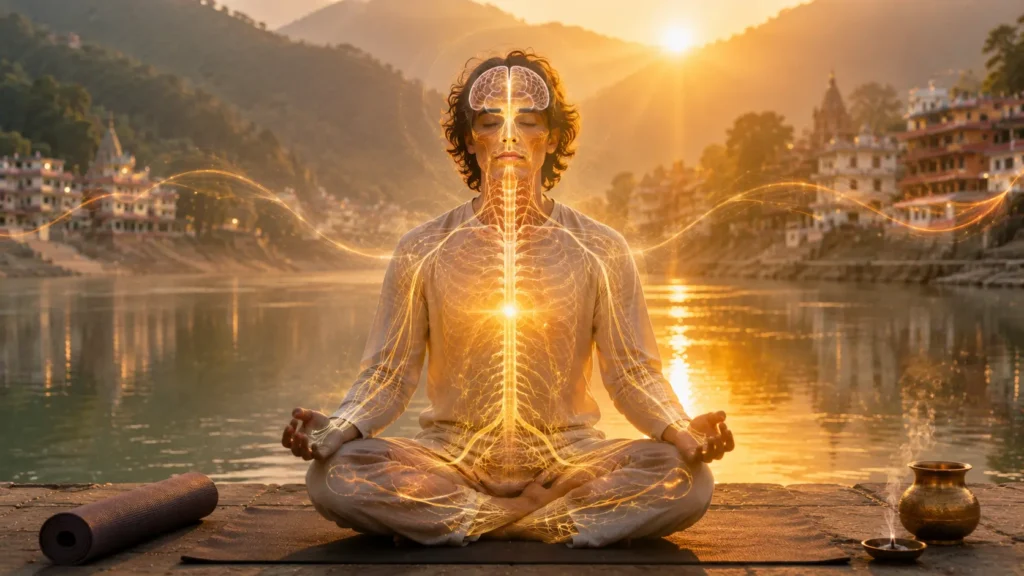
Clinical research on Yoga Nidra and yoga for anxiety and depression has documented its use in PTSD treatment among veterans, its effects on insomnia, and its capacity to reduce depressive symptoms significantly more than physical yoga alone when the two are combined. The practice requires nothing physically — the practitioner simply lies down and follows the guidance. This makes it uniquely accessible for those days when depression makes movement feel impossible. A 30-minute Yoga Nidra session is said in the classical tradition to provide the restorative equivalent of several hours of deep sleep. For a nervous system depleted by anxiety or depression, this restoration is not incidental — it is the intervention itself.
How Rishikesh Changes the Practice of Yoga for Anxiety and Depression
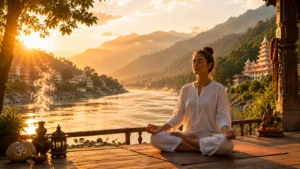
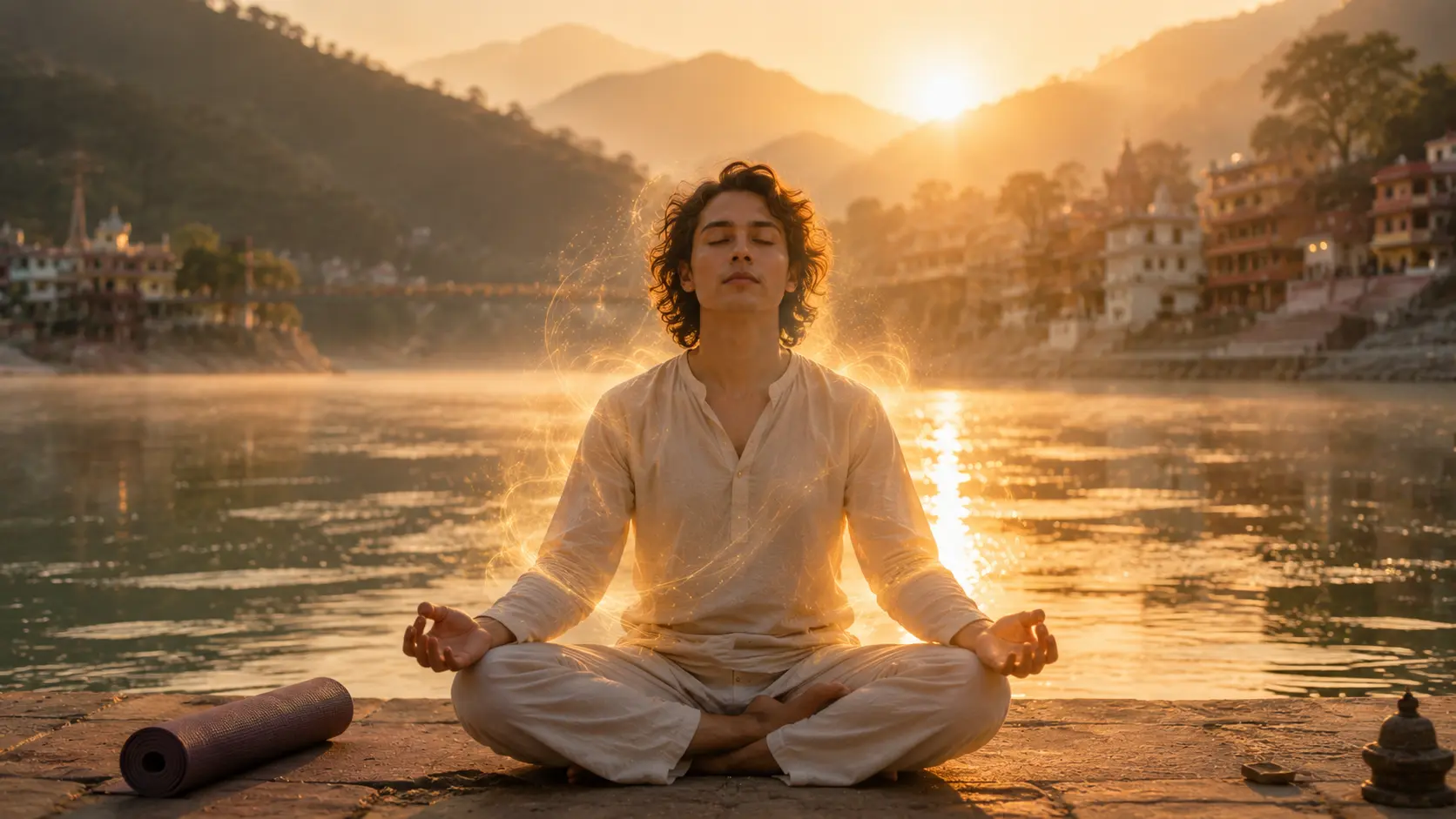
Any practitioner who has used yoga for anxiety and depression in a city studio and then practised the same postures and pranayama in Rishikesh will tell you: it is not the same experience. The environment in which the practice occurs is not neutral. The mountain air, the proximity to the Ganga, the absence of the sensory noise that modern urban life generates constantly — all of these conditions change what the nervous system can access in a practice session.
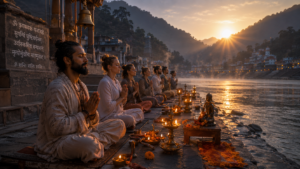
At Triyambakam Yoga Centre in Tapovan, the practice hall is within walking distance of the Ganga. The daily schedule begins before dawn, when the quality of the atmosphere is at its most conducive to deep practice. The food is sattvic — vegetarian, freshly prepared, designed to support a calm and clear nervous system rather than stimulate it. The community of practitioners working alongside each other creates a collective field that amplifies the individual practice. For someone using yoga for anxiety and depression as a therapeutic tool, all of these conditions compound the effect of the practice in ways that a weekly studio class simply cannot replicate.
Students at Triyambakam who arrive carrying anxiety, depression, grief, or burnout consistently report that the shift begins earlier than they expected. Not because the practice is more intense here — but because the conditions around the practice are supporting yoga for anxiety and depression rather than competing with it. The Yoga Retreat in Rishikesh programmes at Triyambakam were designed specifically to create those conditions — a structured daily immersion in yoga for anxiety and depression that works faster and goes deeper than any equivalent programme in an urban setting.
What the Classical Yogic Tradition Says About Anxiety and Depression
The classical yogic texts did not use the terms anxiety and depression. They used the terms rajas and tamas — two of the three gunas, or qualities of nature, that exist in constant flux within every human being. Rajas is the quality of agitation, activity, and restlessness — the energetic signature of anxiety. Tamas is the quality of heaviness, inertia, and dullness — the energetic signature of depression. The third guna, sattva — clarity, balance, and luminosity — is what yoga for anxiety and depression cultivates in the system.
This framework is not merely philosophical. It is practical. When a practitioner understands their anxiety as excess rajas — too much heat, too much movement, too much forward energy without a stable centre — the appropriate practices become clear: grounding asanas, cooling pranayama, restorative postures, mantra that slows the system down. When depression is understood as excess tamas — too much heaviness, too much withdrawal, too much downward energy — the appropriate practices are equally clear: activating backbends, energising pranayama, dynamic sequences that generate heat and lift. Yoga for anxiety and depression in the classical framework is not a generic wellness programme. It is a precision tool — yoga for anxiety and depression calibrated to the individual’s current state.
Yoga for Anxiety and Depression at Triyambakam — What Students Experience
Prof. Anamika founded Triyambakam Yoga Centre with the understanding that the deepest effects of yoga for anxiety and depression require more than correct technique. They require the right environment, the right teacher, and the right community. Students who arrive at Triyambakam carrying anxiety, depression, or the combination of both that so frequently appears together — anxiety as the active face and depression as the exhausted one — consistently report a progression that follows the same arc.
In the first two to three days, the body adjusts. The early schedule, the sattvic food, and the absence of the digital noise that anxiety feeds on begin to create space. By the middle of the first week, the practice starts to land differently — deeper, quieter, more felt. By the end of a 7-day programme, most practitioners describe a quality of inner stillness that they had not experienced in years, if ever. For those who stay for 14 days, the effects stabilise in a way that carries home — not as a memory of feeling good in Rishikesh, but as an actual change in how the nervous system responds to daily life. This is yoga for anxiety and depression working as the tradition always intended it to work: not as symptom management but as a change in baseline.
Frequently Asked Questions About Yoga for Anxiety and Depression
How long before yoga for anxiety and depression produces noticeable results?
Most practitioners notice an immediate effect on anxiety within a single session — slower breath, quieter mind, reduced physical tension. For measurable reduction in symptoms of depression, consistent practice of 3 to 5 sessions per week over 8 weeks is the threshold most studies identify. An immersive retreat at Triyambakam compresses this timeline significantly because the practice is daily and the environment supports it 24 hours a day.
Should yoga for anxiety and depression replace medication or therapy?
No. Yoga is a powerful complementary approach and is increasingly recommended by mental health professionals as part of a broader treatment plan. It does not replace medical care, and anyone managing a clinical diagnosis should practise in consultation with their doctor or therapist. What yoga offers — and medication and talk therapy often do not — is a somatic, body-level practice that addresses the physiological roots of both conditions directly.
Is yoga for anxiety and depression suitable for complete beginners?
Yes. The practices most effective for anxiety and depression — Hatha yoga, restorative postures, pranayama, Yoga Nidra — require no prior experience and no particular physical fitness. At Triyambakam, students at every level receive individual guidance. The most important quality a beginner brings is not flexibility or prior knowledge but the willingness to show up for the practice consistently.
The Practice That Meets You Where You Are
What makes yoga for anxiety and depression genuinely effective — more so than most approaches that target these conditions — is that it meets the practitioner exactly where they are. An anxious person does not need to be calm before they can begin. A depressed person does not need to be motivated. The practice itself generates the states it requires. The breath slows the heart. The heart calms the mind. The mind, once quiet, begins to see clearly. And from clarity, the decisions, the perspectives, and the responses to life that anxiety and depression had been distorting become available again.
At Triyambakam Yoga Centre in Tapovan, Rishikesh, yoga for anxiety and depression is taught as the classical tradition intended — with the full depth of asana, pranayama, meditation, mantra, and the support of an unbroken lineage. To begin, contact the centre at +91 8006335555 or through the contact form on this website. The centre is located near Lakshman Jhula, Tapovan, Rishikesh, Uttarakhand 249192.