
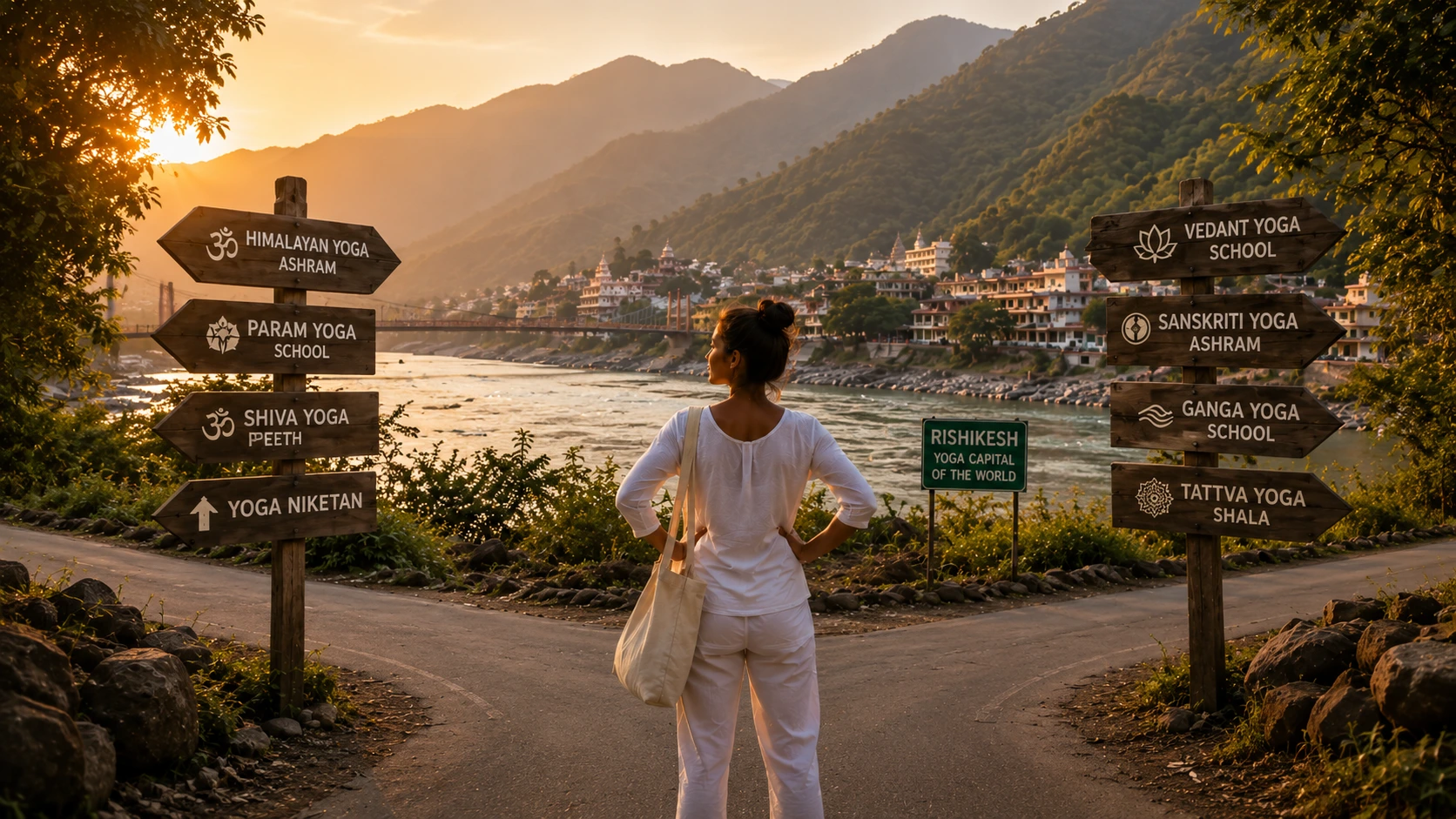
If you have started researching how to choose a yoga school in Rishikesh, you have already discovered the central problem: there are over 500 schools in this city, and almost every one of them will tell you exactly what you want to hear. Authentic lineage. Experienced teachers. Small batches. Transformative experience. The websites look similar. The promises sound identical. And most of the information available online is written by the schools themselves — which means it tells you very little about what you actually need to know.
This page exists to change that. Triyambakam Yoga Centre has been receiving students from over 70 countries for years, and the questions that arrive before enrolment are always the same. What should I actually look for? How do I know if a school is legitimate? What are the things most people miss until it is too late? The answer to how to choose a yoga school in Rishikesh is not complicated — but it requires asking the right questions. This page sets those questions out clearly, with no commercial bias, so you can evaluate any school — including this one — with the same standard.
Why Rishikesh and Why It Matters When Choosing a Yoga School
Before getting into how to choose a yoga school in Rishikesh, it is worth being clear about why Rishikesh matters in the first place. The city sits at the foothills of the Himalayas where the Ganga descends from the mountains. For centuries, yogis, sages, and spiritual seekers have come to this region to practise and to teach. The yogic tradition that developed here is not theoretical — it has been lived, transmitted, refined, and passed down through unbroken lineages in this land for longer than any written record.
This matters practically when thinking about how to choose a yoga school in Rishikesh because not every school in the city connects to that tradition. Some are excellent. Some are commercial operations that use Rishikesh as a backdrop and the word ‘authentic’ as a marketing term. Knowing the difference is the whole point of this page — and it is the whole point of answering how to choose a yoga school in Rishikesh properly.
The 8 Things to Check When Deciding How to Choose a Yoga School in Rishikesh
The most common mistake people make when figuring out how to choose a yoga school in Rishikesh is making the decision based on price, photos, or a persuasive website. These things say almost nothing about what you will actually experience. The eight factors in the table below are what experienced practitioners, teachers, and returning students consistently identify as the real indicators of a school’s quality.
| # | Factor | What to Ask | Red Flag to Watch |
| 1 | Yoga Alliance Registration | Is the school listed on yogaalliance.org? Verify yourself — do not take the website’s word for it. | RYS registration not verifiable on the official Yoga Alliance website |
| 2 | Teacher Presence | Are the teachers resident throughout the programme, or do they visit occasionally? | Impressive teacher profiles where the teachers are absent for most of the programme |
| 3 | Teacher Lineage | Who trained the teachers? Who trained their teachers? Is there a traceable lineage? | Certifications listed without any mention of mentors, training background, or personal practice years |
| 4 | Batch Size | How many students are in each batch? Is individual attention guaranteed? | Batches larger than 25 students with no mention of individual feedback or adjustment |
| 5 | Written Curriculum | Can the school provide a day-by-day or week-by-week curriculum before you enrol? | Vague descriptions of what will be covered — “yoga, meditation, philosophy” with no specifics |
| 6 | Student Reviews | Are reviews available on third-party platforms — Google, Tripadvisor, BookYogaTeacherTraining? | Only testimonials on the school’s own website with no way to verify them independently |
| 7 | Fee Transparency | Does the quoted price include accommodation, meals, Yoga Alliance registration fee, and materials? | Price that seems too low — often means hidden costs or compromised quality |
| 8 | Teaching Philosophy | Does the school’s approach — traditional vs modern, physical vs spiritual — match what you are looking for? | Schools that promise everything to every student with no defined approach or lineage |
How to Verify Yoga Alliance Registration — Step by Step
This is the single most skipped step in how to choose a yoga school in Rishikesh, and the one that causes the most regret when ignored. Yoga Alliance registration is not something a school can fake — or rather, it can claim it on a website, but you can verify the truth in under two minutes.
Go to yogaalliance.org and use the search function to find the school by name. If the school appears as an active RYS (Registered Yoga School) with the correct address and programme hours, the registration is genuine. If it does not appear — or if it appears as expired or inactive — the school’s certification claim is false and the certificate you receive will not be internationally recognised. This one check answers a large part of how to choose a yoga school in Rishikesh for anyone whose goal includes teaching internationally.
The Teacher Question — The Most Overlooked Factor
Every experienced practitioner who has gone through the process of how to choose a yoga school in Rishikesh names the same thing in hindsight: the teacher is everything. The curriculum, the location, the price — all of these matter far less than the quality and consistent presence of the person standing at the front of the room every morning.
There are two types of teachers in Rishikesh schools. Resident teachers are there every day, living the practice alongside the students, available for questions and individual guidance throughout the programme. Visiting teachers come in for a session or two and leave. Most school websites list both types under the same heading and give them equal billing — which is how how to choose a yoga school in Rishikesh becomes so confusing. The simple fix is to ask the school directly: which teachers will be present every single day of my programme?
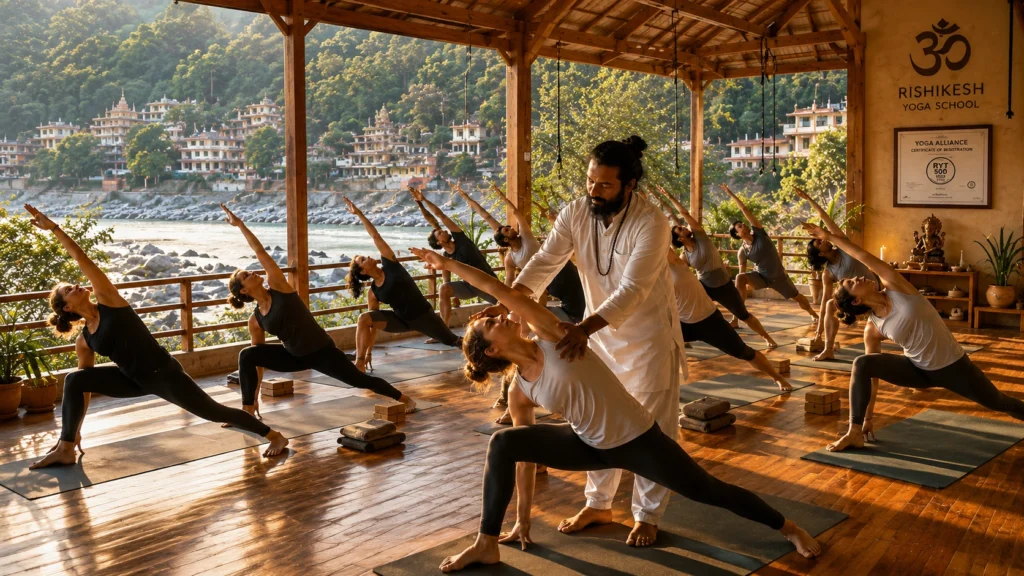
At Triyambakam Yoga Centre, Prof. Anamika and the resident teaching team are present throughout every programme. This is not incidental — it is a deliberate commitment that reflects the classical understanding of how yoga is transmitted. The tradition has always required a continuous relationship between teacher and student, not a series of disconnected masterclasses. When thinking about how to choose a yoga school in Rishikesh, this distinction is not a minor detail. It is the difference between receiving a transmission and attending a series of workshops.
Lineage — What It Means and Why It Matters
Lineage is one of the terms most frequently used and least frequently explained in discussions of how to choose a yoga school in Rishikesh. A lineage is a living chain of transmission — teacher to student, generation to generation, in which the practice is passed not only as information but as direct experience. A teacher who received the practice through a genuine lineage teaches differently from one who compiled their training from multiple certification courses. This is one of the most important distinctions in how to choose a yoga school in Rishikesh.
When evaluating how to choose a yoga school in Rishikesh, ask the school to trace the lineage of its lead teacher. Who trained them? Who trained that person? Does the line lead back to a recognisable tradition — Sivananda, Krishnamacharya, the Tantric tradition, classical Hatha? If the school cannot answer this question clearly, the teaching is likely a compilation rather than a transmission.
At Triyambakam, the lineage is traceable. Prof. Anamika’s training spans the classical Hatha yoga tradition rooted in the Hatha Yoga Pradipika and the Shakti-Kundalini lineage with direct Tantric roots. Students who come having researched how to choose a yoga school in Rishikesh and applied the lineage question consistently say that Triyambakam is among the very few schools where the answer is both clear and deep.
Batch Size and Why It Changes Everything
Batch size is a factor that almost every guide on how to choose a yoga school in Rishikesh mentions, but very few explain why it matters so specifically. The reason is this: yoga, in the classical tradition, is not a group fitness class. It is an individual practice that happens to take place in a group setting. That distinction is fundamental to how to choose a yoga school in Rishikesh correctly. A teacher who is working with 10 students can see each person’s alignment, notice who is struggling, and offer adjustments and individual guidance throughout the session. A teacher working with 40 students cannot.
The ideal batch size for meaningful yoga teacher training, according to both experienced practitioners and school founders who have tried different formats, is between 10 and 20 students — a point every guide on how to choose a yoga school in Rishikesh agrees on. Beyond 25, individual attention becomes genuinely difficult regardless of how skilled the teacher is. When researching how to choose a yoga school in Rishikesh, ask specifically what the maximum batch size is for the cohort you would join — and if the school will not commit to a number, treat that as an answer in itself.
Choosing the Right Programme Type for Your Goals
Knowing the programme type is part of how to choose a yoga school in Rishikesh is choosing the right type of programme, not just the right school. A 200-hour Teacher Training and a 7-day retreat are very different experiences — and the right choice depends entirely on what you are actually coming to Rishikesh to do.
| Programme Type | Duration | Best For | Outcome |
| 7-Day Yoga Retreat | 1 Week | First-time visitors, stress relief, exploratory | Personal reset — no certification |
| 14-Day Yoga Retreat | 2 Weeks | Deeper immersion without teacher training commitment | Deepened practice — no certification |
| 100-Hour TTC | 2 Weeks | Practitioners wanting foundational training | Yoga Alliance registered certificate |
| 200-Hour TTC | 4 Weeks | Anyone seeking full international teaching certification | RYT-200 — globally recognised |
| 300-Hour TTC | 4 Weeks | Certified teachers seeking advanced qualification | RYT-500 when combined with 200-hour |
| Kundalini Programme | Varies | Practitioners focused on energy body and spiritual depth | Specialised Kundalini certification |
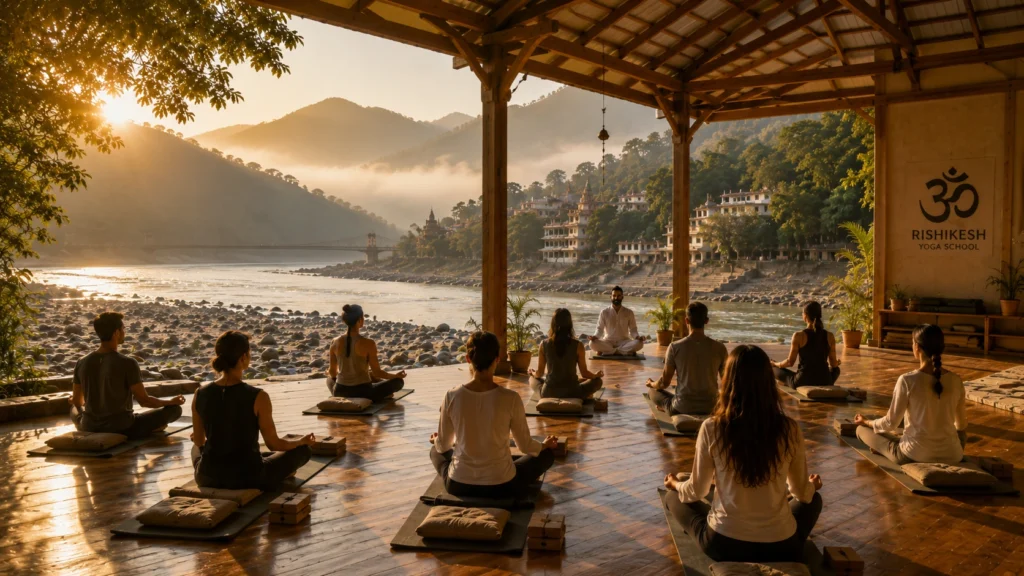
For those who want to experience Rishikesh without committing to a full training programme, a Yoga Retreat in Rishikesh at Triyambakam is often the right starting point. The retreat provides a structured immersion in Hatha yoga, pranayama, meditation, and mantra — with the Ganga as the backdrop and the Triyambakam lineage as the foundation. Many students who begin with a retreat return for the full Teacher Training the following year. The how to choose a yoga school in Rishikesh question becomes much easier to answer after you have spent a week in a school’s actual environment.
Questions to Ask Before You Enrol in Any Yoga School in Rishikesh
A clear list of direct questions is one of the sharpest tools available when working out how to choose a yoga school in Rishikesh is simply knowing which questions to ask — and paying careful attention to how a school responds. Schools that are confident in their quality will answer these questions directly and without hesitation. Schools that deflect, give vague answers, or redirect to their website instead of responding to a specific question are showing you something important about what to expect.
| Question to Ask the School | Why It Matters |
| Will my primary teacher be present every day of the programme? | Many schools hire visiting teachers — your lead teacher may be absent for days at a time |
| Can I see the week-by-week curriculum before I enrol? | A school confident in its curriculum will share it freely — vague answers are a warning sign |
| What is the maximum batch size for my cohort? | Ideal batch size is 10–20 students; beyond 25 and individual attention becomes very difficult |
| Is the Yoga Alliance registration fee included in the quoted price? | Many schools quote a training fee and then add the YA registration separately — often $200+ |
| Where did your teachers train, and under which lineage? | Lineage matters — a teacher who received the practice through a living transmission teaches differently from one who completed a course |
| Are accommodation and meals included, and can I see the rooms? | Accommodation quality varies enormously — always request photos of actual rooms, not stock images |
Red Flags — What to Walk Away From
The negative list is as important as the positive one when working out how to choose a yoga school in Rishikesh. The following patterns consistently indicate a school that will not deliver what it promises.
A price that is dramatically lower than comparable schools usually means something has been cut — teaching quality, accommodation standard, included meals, or Yoga Alliance registration fees. When figuring out how to choose a yoga school in Rishikesh, remember: in Rishikesh a 200-hour TTC that includes accommodation, meals, and materials typically starts around ₹55,000 and can reach ₹1,20,000 for programmes with genuine depth and small batches. If a school is offering a full programme at half the market rate, ask specifically what is not included. Price-led decision making is the most common mistake in how to choose a yoga school in Rishikesh.
Teacher profiles that list long certification histories without mentioning lineage, mentors, or years of personal practice are another warning sign. Certifications are not the same as transmission. A teacher with three 200-hour certificates from three different commercial trainings has accumulated paperwork, not necessarily depth. How to choose a yoga school in Rishikesh ultimately comes down to this question: has the teacher been changed by the practice, or have they simply completed a course?
Finally, schools that cannot or will not provide a written curriculum before enrolment are asking for your commitment without offering theirs. A well-run programme has a clear, detailed day-by-day structure. If a school describes its curriculum as flexible or improvised, that may suit a free-form workshop but it is not appropriate for a professional teaching certification. This point alone rules out a large number of schools for any practitioner who is serious about how to choose a yoga school in Rishikesh.
How Triyambakam Yoga Centre Measures Against These Standards
Applying the full framework for how to choose a yoga school in Rishikesh to Triyambakam Yoga Centre directly — this is what the school offers against each criterion.
| Factor | Average Rishikesh School | Triyambakam Yoga Centre |
| Teacher Presence | Mix of resident and visiting teachers | Prof. Anamika and resident teachers present throughout |
| Lineage | Certification-based; lineage rarely traceable | Classical Hatha + Shakti-Kundalini lineage under Prof. Anamika |
| Batch Size | Often 20–40+ students | Intentionally small cohorts for individual attention |
| Curriculum Depth | Asana-heavy; philosophy and pranayama secondary | All six pillars of Hatha yoga taught in equal depth |
| International Reach | India-based only | Students from 70+ countries; global workshops in USA and Europe |
| Location | Varies across Rishikesh | Tapovan, near Lakshman Jhula — direct Ganga access |
Frequently Asked Questions About How to Choose a Yoga School in Rishikesh
What is the single most important thing to check when deciding how to choose a yoga school in Rishikesh?
Verify Yoga Alliance registration yourself on yogaalliance.org. After that, confirm which teachers will be present throughout the programme — not just listed on the website.
How much does a 200-hour TTC typically cost in Rishikesh?
Most programmes charge between ₹55,000 and ₹1,20,000 depending on what is included. Always ask for a full cost breakdown — accommodation, meals, materials, and Yoga Alliance registration fee — before comparing prices across schools.
Is it better to visit a school before enrolling?
Yes, if possible. Triyambakam Yoga Centre offers a free one-week trial class precisely for this reason — so that prospective students can experience the teaching, the environment, and the community before making a full commitment. This is one of the most honest answers to how to choose a yoga school in Rishikesh: the right school will welcome you to come and see for yourself.
Can beginners attend a 200-hour TTC in Rishikesh?
Many programmes in Rishikesh accept beginners. At Triyambakam, students arrive at every level. The important question is not prior experience but the depth of the student’s commitment to the practice — and that is something the teaching team can assess in a conversation before enrolment.
The Decision That Changes What Comes After
Knowing precisely how to choose a yoga school in Rishikesh is not just about avoiding a bad experience. It is about creating the conditions for the best one. The right school — found through a careful process of how to choose a yoga school in Rishikesh — the right teacher — these two elements together answer how to choose a yoga school in Rishikesh better than any checklist — combined with the right personal commitment, and the right programme — found by asking how to choose a yoga school in Rishikesh with rigour — at the right time in a practitioner’s life can shift things permanently — not because the experience is comfortable, but because it is real. The yoga tradition in Rishikesh has been producing these shifts for centuries. The question of how to choose a yoga school in Rishikesh is the question of finding the part of that tradition that is genuinely alive and genuinely being transmitted — not merely being described.
Triyambakam Yoga Centre at Tapovan, Rishikesh, offers one direct answer to how to choose a yoga school in Rishikesh question with an offer: a free one-week trial class for students who want to answer the how to choose a yoga school in Rishikesh question with direct experience rather than research alone. Teacher Training dates, retreat programmes, and Kundalini Awakening intensives run throughout the year. Contact the centre at +91 8006335555 or through the contact form on this website. The centre is located near Lakshman Jhula, Tapovan, Rishikesh, Uttarakhand 249192.